Egyptian Art 2 Sided Figurine With Woman on One Side and Man on the Back Side
Ancient Dinosaur Depictions
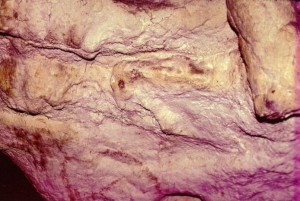
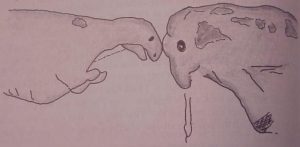 To the right is a picture of what appears to be a bipedal dinosaur with small arms in head-to-head combat with a mammoth from the volume Buried Alive past Dr. Jack Cuozzo (click to enlarge). Information technology was taken by the author in Bernifal Cave, one of the caverns in French republic that is renowned for Neanderthal art. Mammoth drawings are non unusual in such cavern art, simply the delineation of an apparent theropod dinosaur is remarkable.
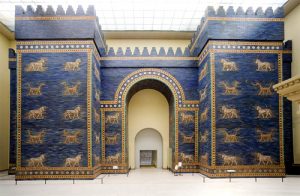
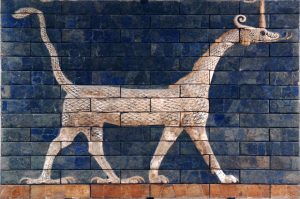
In 600 BC, under the reign of Male monarch Nebuchadnezzar, a Babylonian artist was commissioned to shape reliefs of animals on the structures associated with the Ishtar Gate. Many centuries later German archaeologist Robert Koldewey stumbled upon the blue-glazed brick and that gate was rediscovered in 1899. The animals announced in alternating rows with lions, fierce bulls (rimi or reems in Chaldean), and curious long-necked dragons (sirrush). The lions and bulls would accept been present at that time in the Center E. But, on what creature did the ancient Babylonians model the dragon? (click the depiction to enlarge) Koldewey believed that the sirrush was a portrayal of a existent animal and in 1918, he proposed that the dinosaur Iguanodon was the closest known match to the sirrush. The same discussion, sirrush, is mentioned in the book of Bel and the Dragon, from the Apocrypha. Both the description at that place and the image on these unearthed walls, which are at present displayed in the Berlin Vorderasiatisches Museum, appear to fit a sauropod dinosaur. (Shuker, Karl P.N., "The Sirrush of Babylon," Dragons: A Natural History, 1995, pp. seventy-73.)
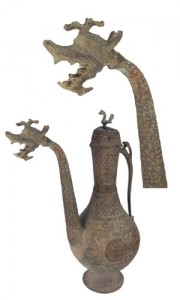
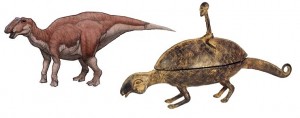
To the right is a bronze Persian pot manufactured toward the stop of the 1st Millennium AD that is part of the Genesis Park drove. The most fascinating element of this vessel is the stylized, scaled dinosaur-similar dragon that forms the spout. Dragons class an integral part of Persian mythology and behavior. The ceremonial undertones of this vessel lead u.s.a. to believe that it was associated with Zoroastrianism. Several malevolent dragon-like creatures are mentioned at various points in the Zoroastrian scriptures. Ane such popular dragon myth involves Azi Dahaka – a three-headed Persian dragon that will devour one tertiary of all men and animals at the end of the world.
 Although the Ottoman Empire ruled for over 6 centuries, there are not many depictions of dinosaurian creatures in their artwork (as compared to Medieval European art). Perchance dragons were non as common in the eastern European/Middle Eastward theater at that time. The Turkish painting to the left, entitled "Procession of the Merchandise Corporation during the Festival of 1720 in Constantinople" is in a surname (or historical anthology) chosen The Surname-I Hümayun archived at Topkapi Museum of Istanbul. It was written and illustrated under the direction of Abdulcelil Levni (aka Abdulcelil Çelebi) who was the official Ottoman court painter till he died in 1732. The pic shows the guildsmen, followed by clowns and what seems to be a mechanical iii-headed dragon. (Click for an enlargement of the dragon.) Note the similarity to a baby sauropod dinosaur. A sauropod with multiple heads, a condition known as polycephaly, while curious, is inappreciably unknown among dinosaur reports.
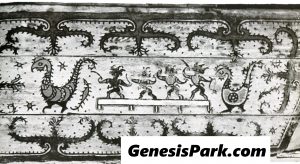 Upward till the colonial period of the 1800s the Dayak peoples of Kalimantan and Sumatra produced multiple pieces of fine art depicting long-tailed, long-necked creatures with a headcrest. Dayak mythology tells of a fourth dimension, before the creation of man, when the ocean was the habitation of a mighty underworld dragon who opposed the gods of the sky. The artwork to the right seems to testify warriors on a platform fighting crested dragon-like animals. The creatures on this particular art, which is housed in the Ethnographical Museum of Budapest, behave a hitting resemblance to the hadrosaurids species Corythosaurus and Lambeosaurus. They are apparently being hunted by these aboriginal Indonesian peoples. (Bodrogi, Tibor, Fine art of Republic of indonesia, 1972, plate x.)
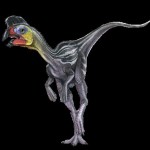
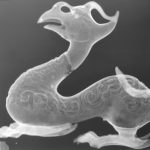
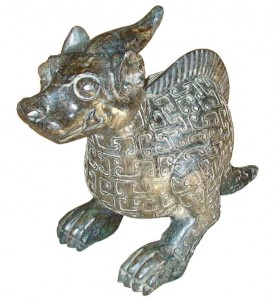
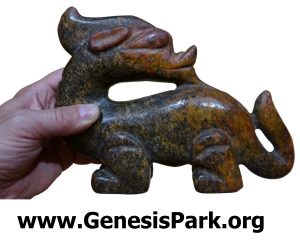
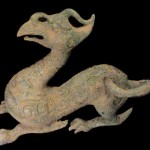 Chinese stories and stylized dragon depictions are fairly common. But an unusual beaked dragon statue came up on the antiquities market and is now in the Genesis Park collection. The bronze styling on this artifact suggests it is from the Han Dynasty (206 B.C. – A.D. 220). It displays numerous characteristics of the beaked dinosaurs (like the Oviraptor depicted alongside for comparison): tridactyl feet configuration, metatarsal opinion, calibration-like representation all over the torso (except for the horn which has a striated pattern), long (albeit slender) tail, elaborate caput crest and a long neck. This piece was submitted for industrial X-Ray authentication and the patina was also chemically tested, showing that the artifact was clearly genuine. A beautifully preserved beaked dinosaur mummy (Edmontosaurus) was discovered in Alberta, Canada in 2013. The specimen sported a fleshy crest atop its head (similar a rooster). Researchers theorized that the hat-like ornament was brightly colored to allow for identification. This was the outset non-bony crest discovered on a dinosaur. It closely matches the look of the Chinese beaked dragon.
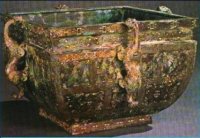 Another fascinating Chinese antiquity is the Late Eastern Zhou Sauropod (Fang Jian) ornamental box to the right. Displaying a long neck and, this depiction is compelling likeness to a Brachiosaurus. (Fong, Wen ed., The Groovy Statuary Historic period of Red china, Metropolitan Museum of Art, 1980, p. 285.) The
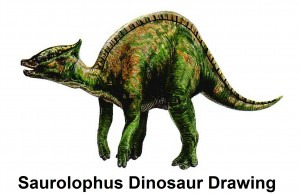
 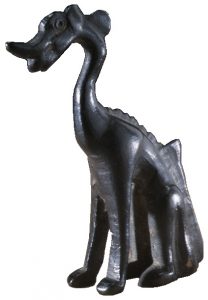 seated dragon sculpture in cast bronze to the left comes from the Tang Dynasty and is currently housed at the Los Angeles County Museum of Fine art. Many more than such sauropodomorph-like Chinese dragon depictions could be considered from this time period, like the painted ceramic dragon to the lower left, identified by the exhibiting museum every bit Tang Dynasty (618-906 AD). Adjacent nosotros consider an even older dragon artifact from the Shang dynasty (1766-1122) that was advertised on the Chinese antiquities marketplace as a dinosaur depiction. It displays relief lines in a calibration-like pattern, a broad beak, a dermal frill, and a headcrest that is strikingly similar the dinosaur Saurolophus (shown below on the right). This jade statute, now in the Genesis Park collection, is fabricated of white colored nephrite with differential weathering, cleaving veins and earth penetration, demonstrating authenticity. (Click to enlarge.)
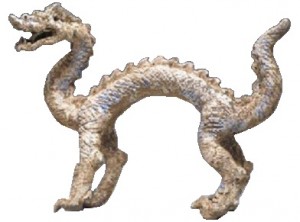
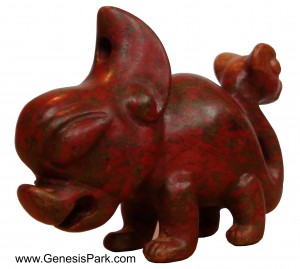
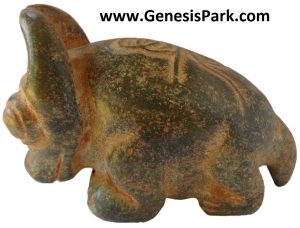
Nigh 4,000 years agone, the Hongshan culture in Mainland china produced many wonderful jade dragon carvings (along with other articulate creature representations). Over time these dragon productions became highly stylized and were especially pop as pendants. Nearly of these ornamental pieces barely resemble a big reptile, but some of the older dragon statues appear to be attempts at modeling sure dinosaurs. Observe the resemblance these jade dragons immediately below behave to a small Protoceratops dinosaur. Some of the Hongshan dragons, like the piece to the lower right, accept longer necks. They announced more like the ceratopsian Udanoceratops. All 3 of these aboriginal pieces are part of the Genesis Park collection.

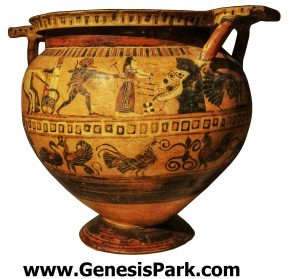 The February 26, 2000 upshot of Science News independent an article that commented on a Hesione vase artifact housed at the Boston Museum of Fine Arts (Hesman, 2000). On this ancient Greek vase are a series of somewhat unusual paintings, including ane that portrays a monster with the head of a dinosaur. This pottery was created effectually 550 B.C. and depicts the Greek hero Herakles rescuing Hesione from this "Monster of Troy." Forced to concede that it is an amazingly realistic dinosaurian depiction, Science News concluded that the paintings on this unusual vase simply bear witness that ancient people dug up and assembled fossils. But there is no evidence for such sophisticated Ancient Paleontologists.
A 1971 landslide in the Girifalco region of southern Italy brought to light hundreds of aboriginal artifacts of a pre-Greek civilization. A lawyer named Mario Tolone Azzariti asserts that he establish some dinosaurian representations among them (pictured below). To the left is a terracotta statue measuring about 18 cm long, shaped remarkably like a Stegosaurus dinosaur. The triangular plates run down its dorsum to the creature'due south tail.
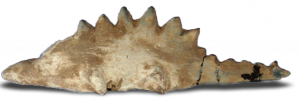
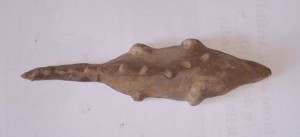
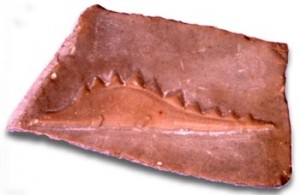
In the view from above (center) the object reveals a strange curving of the plates, as if the animal had been represented lumbering from side to side. The legs are big and awkward, as if conveying great weight, not at all like those of a lizard. In that location is besides a clear representation of a Stegosaurus on a slice of broken pottery (right).
The antiquity below is a Mesopotamian jasper cylinder seal from the Uruk Period (about 3500 BC). This object is currently housed at the Louvre. The creature on the correct is an artist's conception of an Apatosaurus. 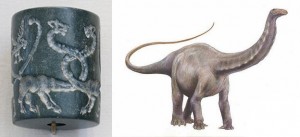 There are many hit similarities betwixt these 2 depictions. The long neck, tail, legs and feet on the artifact conspicuously fit the sauropods amend than any other type of fauna. The biggest difference is at the caput. Cartilage forming the shape of a frill or ears may be stylized or accurate (since there is no way to know from the skeletons we have today). Every bit for the musculature, the ancient creative person draws with stunning realism. Ane has to ask where the artist got the model to depict so convincingly the trunk of a sauropod.
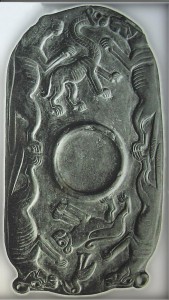
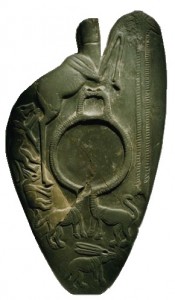 The January 2003 issue of National Geographic magazine presents an artifact described as a "corrective palette . . . from a cemetery of the first dynasties in Manshaat Ezzat." These long-necked creatures displayed on page 78 fit the design of other ancient dinosaur-like depictions, including arching, muscular necks and stout bodies. This artifact depicts many lifelike animals (including a giraffe on the opposite).
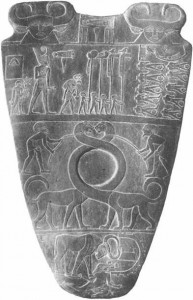
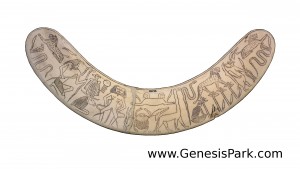
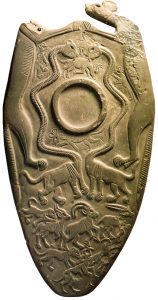 To the far right is displayed the Narmer Palette, which dates dorsum to about 3,100 BC. It is from the aboriginal Egyptian capital of Hierakonpolis and shows the triumph of King Nar-mer with long necked dragons that appear to be in captivity. Immediately to the right is the Two Dog Palette from the aforementioned catamenia. Information technology is displaying a pair of "dinosaur-similar" creatures along with numerous clear representations of living animals (conspicuously not fatigued to scale).
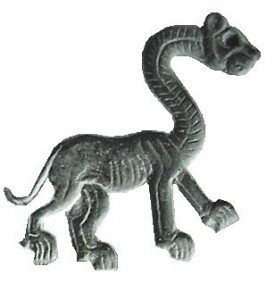
An Egyptian apotropaic wand (or magical "knife") dating from most 1750 BC displays a similar long-necked beast. Made from hippo tusk ivory, this artifact is currently housed in the British Museum. The preponderance of these long-necked depictions in ancient art motivated archaeologists who practice not believe men and dinosaurs coexisted to invent a name for this particular creature. It is called a "serpopard," supposedly a mosaic of a serpent and a leopard. Simply for those who believe that homo was created in the commencement alongside the groovy reptiles, these palettes seem to exist an attempt to draw a sauropod dinosaur. Annotation the "Four Dogs Palette" with the "serpopard" cut out for clarity.
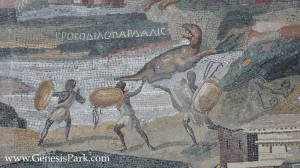 To the left is a beautiful mosaic that was one of the wonders of the second century world. (Click to overstate or run across The Nile Mosaic of Palestrina for more than details). Housed in Palestrina, which is but south of Rome, this masterpiece depicts Nile scenes from Egypt all the mode up into Ethiopia. Scholars now believe this is the work of Demetrius the Topographer, an artist from Alexandria who came to piece of work in Rome. The peak portion of this remarkable piece of art is generally believed to depict African animals being hunted past black-skinned warriors. These Ethiopians are pursuing what appears to exist some type of dinosaur. The Greek Messages above the reptilian animal in question are KROKODILOPARDALIS, which is literally translated Crocodile-Leopard (apparently identifying an agile reptilian creature). The flick shown here is only a pocket-size portion of the massive mosaic. It also contains clear depictions of known animals, including Egyptian crocodiles and hippos.
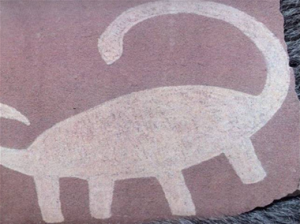
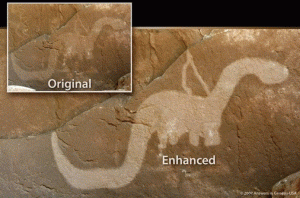
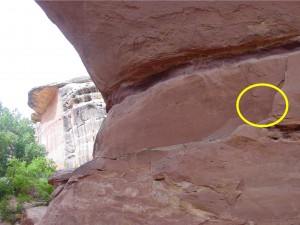
The motion picture above (on right) was drawn past North American Anasazi Indians that lived in the expanse that has now go Utah between 150 B.C. and 1200 A.D. Fifty-fifty noted anti-creationists agree that it resembles a dinosaur and that the brownish film which has hardened over the picture, along with the pitting and weathering, attests to its age. One evolutionist wrote, "There is a petroglyph in Natural Bridges National Monument that bears a startling resemblance to a dinosaur, specifically a Brontosaurus, with a long tail and cervix, small head and all." (Barnes, Fred A., and Pendleton, Michaelene,Prehistoric Indians: Their Cultures, Ruins, Artifacts and Rock Art, 1979, p.201.) Clearly a native warrior (on the left to a higher place the dinosaurian figure) and an Apatosaur-similar creature are depicted in this carving located near Lake Powell, UT. Another Native American rock pictograph found in a Utah's White Canyon region (upper left) besides seems to depict a sauropod dinosaur.
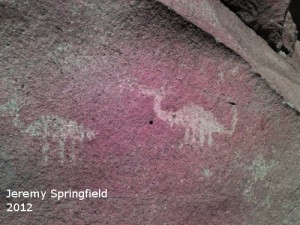
The petroglyph above to the left was discovered in 2012 by Jeremy Springfield on a trip to Hidden Mountain, merely exterior of Los Lunas, New Mexico. S8int website brought his story to our attention. The drawing is located on an isolated, inaccessible ledge near a very clear deer petroglyph. What were the ancient Pueblo peoples intending to depict, if not a living dinosaurian animate being that they knew from that region?
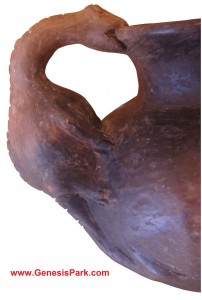
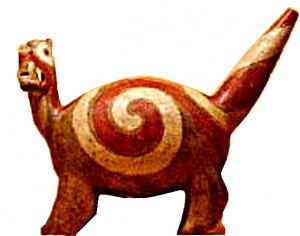
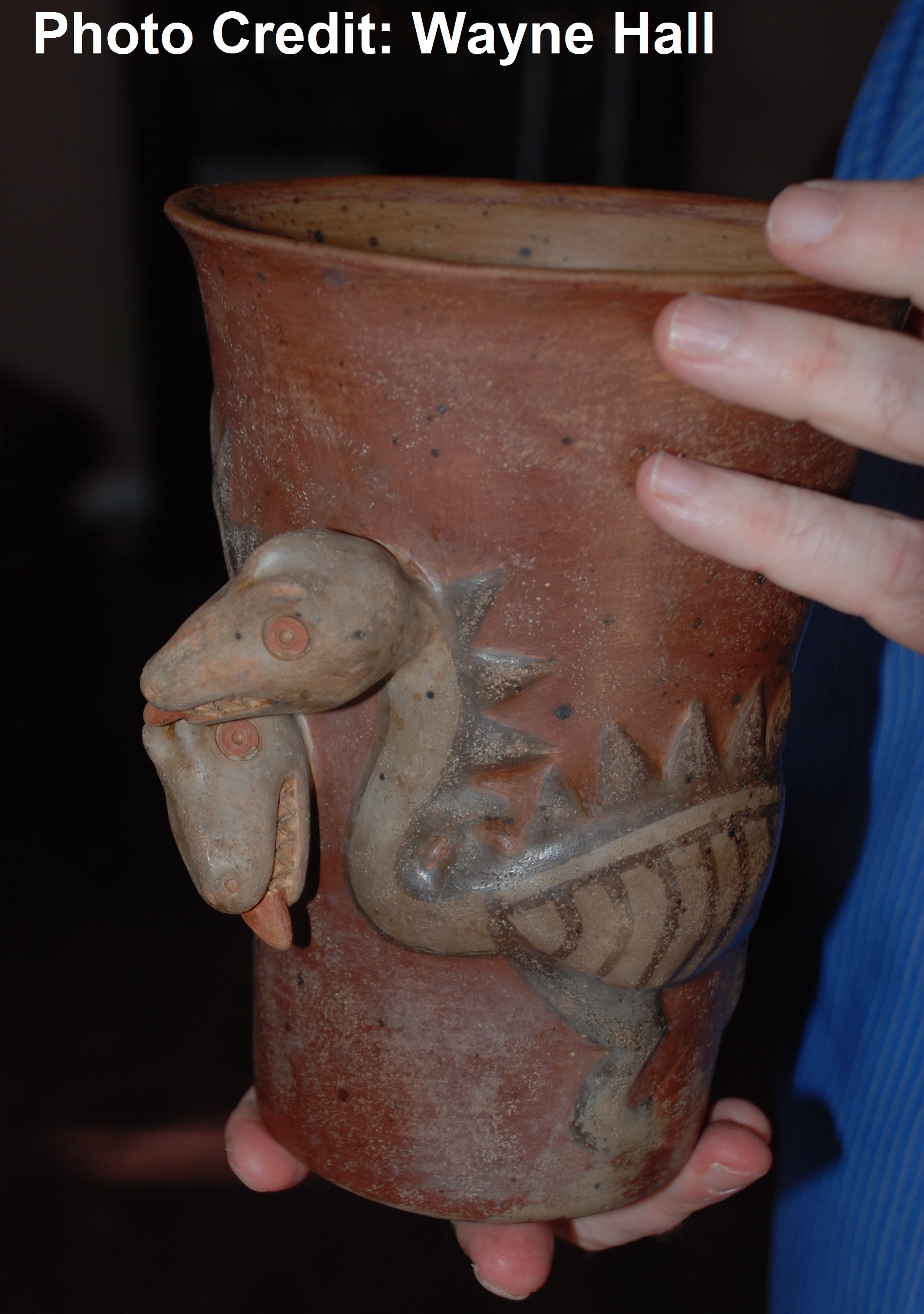
The Mississippian culture flourished from 800 – 1500 Advertisement through the southwestern United States and information technology is known for their edifice of mounds. Above in the center is a curious piece from this culture (click to overstate). Patently the swirling design on its sides signifies that the creature in question lived in water, while the eye markings insinuate to the beast's unusually keen vision. Some of these Indian depictions of this rotund animal show tridactyl anxiety, a long cervix and prominent tail held aloft. In a higher place to the right, note the handle on a Mesoamerican pottery object made by Mississippi Caddo Indians. It seems to display a baby dinosaur. This circa 1200 AD antiquity is housed at Creation Bear witness Museum in Texas (click to overstate).
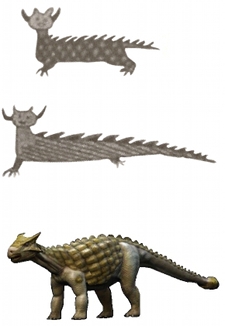 Henry Rowe Schoolcraft was a geologist and Indian agent who wrote extensively about the Sioux Indians. He heard stories about a monstrous creature chosen Unktehi, something like an ox only much larger, with great horns. Schoolcraft reproduced drawings of several types of Unktehi monsters on birchbark around 1850. These were based upon rock art describing a war party of five canoes crossing Lake Superior that encountered animals resembling giant turtles, snakes, and moose. But some (upper correct) clearly look dinosaurian. Sioux Indians further w, when interviewed by ethnologists, described Unktehi as an immense reptile or ophidian with legs. He was shaped like a giant scaly snake with feet and a notched backbone or crest similar a behemothic saw and had a heavy spiked tail. Still other
 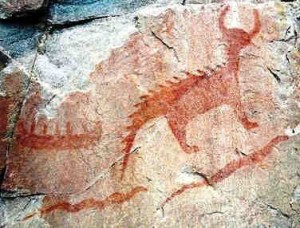 Indian reports describe Unktehi as a swamp-dwelling creature. Adrienne Mayor, an evolutionist, believes that the Sioux were weaving stories about fossils they encountered. (Mayor, Fossil Legends of the Offset Americans, 2005, pp. 235-237.) Just the pictures and clarification bring to mind the dinosaur Ankylosaurus (lower right) with a depression slung body, long tail, heavy armor, and prominent multiple horns. A plated and horned animal has likewise been discovered in Ojibwa Indian art (left – click to enlarge) on the Agawa Rock at Misshepezhieu, Lake Superior Provincial Park, Ontario, Canada.
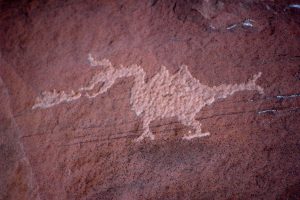 On the right is shown a photo of ane of the curious "dinosaur" petroglyphs almost Middle Mesa at the Wupatki National Park. This particular petroglyph is called "Puff the Magic Dragon," and appears to exist a depiction of a fire-breathing dinosaur. Though at that place is no certain fashion to appointment such petroglyphs, this carving is believed to be at least several hundred years erstwhile.
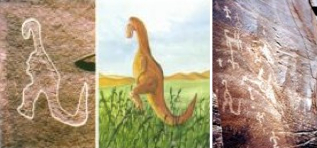 On two occasions in the belatedly 1800s, Samuel Hubbard, Curator of Archaeology of the Oakland Museum, visited an expanse of the Grand Coulee known as the Havasupai Canyon. Every bit an evolutionist, he was amazed to find a petroglyph (carved rock drawing) of an elephant made by Native Americans. But some other depiction was "cut into the sandstone much more deeply than the elephant." Its pinnacle was 11.2 inches, with a neck approximately v.one inches in length and a tail of 9.1 inches. Hubbard photographed the petroglyph and somewhen placed information technology in his scientific monograph Discoveries Relating to Prehistoric Homo (1925, p. 10). What kind of animal is it? Dr. Hubbard believed that he had constitute an ancient cartoon of a dinosaur. He wrote, "The fact that some prehistoric human being made a pictograph of a dinosaur on the walls of this canyon upsets completely all of our theories regarding the antiquity of man. Facts are stubborn and immutable things. If theories exercise not square with the facts and then the theories must change, the facts remain." (Doheny, E. L.,Discoveries Relating to Prehistoric Human being by the Doheny Scientific Expedition in the Hava Supai Canyon Northern Arizona, 1924, p. v.) In the far left moving picture, Paul Taylor compares this ancient drawing to the Edmontosaurus. (Click to overstate the picture – courtesy of Don Patton.)
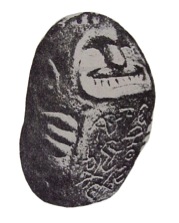
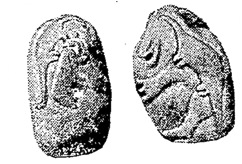
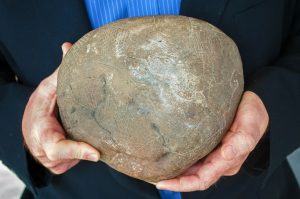
A similar association of an American elephant and dinosaur is presented in the Granby Idol. This queer stone relic was unearthed past W.Fifty. Chalmers near Grand Lake, loftier in the Colorado Rockies. He plant the 66 pound stone (forth with diverse ancient utensils) several feet below the surface while enlarging an irrigation reservoir on his homestead. The rock was made of an exceedingly hard dark-green material, like zilch e'er known of in the neighborhood. ("Is Pre-Glacial Human Coming Dorsum?" Hutchison News, January 5, 1923.) On one side is a carved man, belongings a tablet containing symbols. On the back are carved a mastodon and two dinosaurs. (Click to enlarge. Courtesy of s8int.com.) According to The Le Grand Reporter in 1923, Jean Allard Jeancon, archaeologist and Curator of the Colorado Historical and Natural History Society, stated, "If this stone can be proven genuine, it is the biggest find in all anthropological research and antedates anything on the American continent and is going to establish the remote antiquity of man. I have never seen such remarkable outlines of dinosaurs and mastodons!" Unfortunately this priceless artifact appears to have been lost somewhere in the bowels of the museum system. (Murphy, Jan, Mysteries and Legends of Colorado: Truthful Stories of the Unsolved and Unexplained, 2007.) If a schoolhouse teacher named Lela Smith had non taken three photos of the Buddha-similar stone, the noesis of this relic would have been lost.
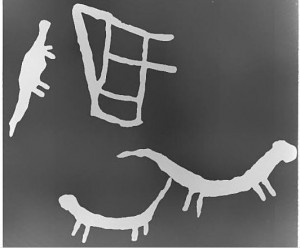
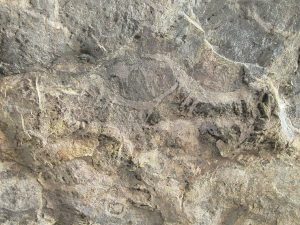 "A fantastic mystery has developed over a set of cave paintings constitute in the Gorozomzi [sic] Hills, 25 miles from Salisbury [renamed Harare]. For the paintings include a brontosaurus – the 67-human foot, xxx-ton-similar creature scientists believed became extinct millions of years earlier man appeared on earth. Yet the bushmen who did the paintings ruled Rhodesia [modern Zimbabwe] from only 1500 BC until a couple of hundred years ago. And the experts agree that the bushmen always painted from life experiences. This belief is borne out past other Gorozomzi Hills cave paintings – accurate representations of the elephant, hippo, buck and giraffe. The mysterious pictures were plant past Bevan Parkes, who owns the land the caves are on. Adding to the puzzle of the rock paintings found by Parkes is a drawing of a dancing bear." (Anonymous, "Bushmen's Paintings Baffling to Scientists," Los Angeles Herald-Examiner, Jan 7, 1970.) To the left is a reproduction of similar rock paintings from a cavern at Nachikufu near Mpika in Zambia (formerly Northern Rhodesia). It shows iii long-necked, long-tailed creatures painted in a dirty white. The best images were obtained by using ultra-violet photography. (Cooke and Clark, Prehistoric Rock Art of the Federation of Rhodesia & Nyasaland , edited by Roger Summers, 1959, pp. 191-194.)
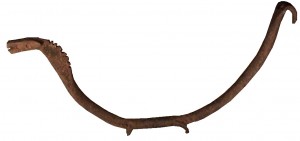 The Bambara peoples of Mali Africa created wonderful wood and iron figurines in the 1800s. Humans, horses, antelopes, and much more than are beautifully portrayed.To the right is an iron figure that was entitled "dinosauriansculpture" by the auctioning gallery. It shows a 4-legged brute with long neck and tail like a sauropod dinosaur. The neck has a slight widening and a ridged frill that makes information technology an especially fascinating depiction. The iron piece is actually a functional tool, with a claw at the end, perhaps used to retrieve a hot pot off the fire.
 Another African tribe from the Mali region produced a dinosaurian object in the mid-1800s. Our friends at the s8int website note that this is the same time frame when Sir Richard Owen coined the term "dinosaur" in England. The bronze antiquity to the left shows a Dogon tribesman riding a long-necked, long-tailed reptilian creature. The oddly bird-like head with strong jawline and ridged head and neck are reminiscent of sure "duck-billed" ornithopod dinosaurs similar the hadrosaurGryposaurus, whose skeleton is found in the Kaiparowits Formation in Utah. The diamond-shaped pattern on the skin matches fossilized skin impressions discovered on a hadrosaur in southern Utah. The sizes of the Dogon passenger and the large-nosed Gryposaurus are modeled roughly in right proportion.
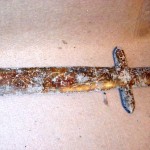 In the 1920s xxx-one Roman-style lead artifacts were excavated near Tucson, AZ (see right). These are described on p. 331 ofDavid Hatcher's book The Lost Cities of Due north & Central America and were featured on the History Channel's 2013 show America Unearthed. These atomic number 82 objects appear to be religious in nature with Hebrew and Latin inscribed upon the swords, spears and crosses. They were cached virtually v feet beneath the desert surface in a layer of caliche (a cement-similar mixture of desert soil and minerals). Skeptics take questioned the authenticity of these artifacts considering the discovery site contains no other artifacts (like pottery, broken drinking glass, bones, ashes or houses) that might validate the existence of Medieval colony. Only peradventure this location was merely a formalism storage location. Supporters bespeak out the value of the significant amount of burial work and expensive lead involved and wonder what the motivation could exist for such an elaborate hoax? Later all, merely one cantankerous weighs 62 pounds!
 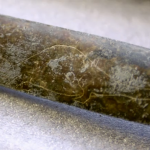 Microscopic analysis of the mineralization build up on the implements seems to debate for them being genuine. A 1972 attempt to dig on location to search for boosted objects was curtailed due to legal challenges. But i of the biggest objections to the authenticity of the Tucson Silverbell artifacts is the precise carvings of an apparent Diplodocus dinosaur on the sword (click right to come across it highlighted). The artifacts accept been stored at the Arizona Historical Society.
Click to see a drawing of the dinosaurian figure.
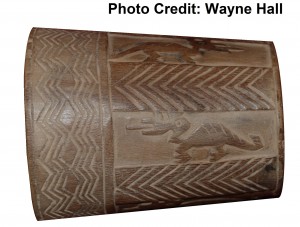
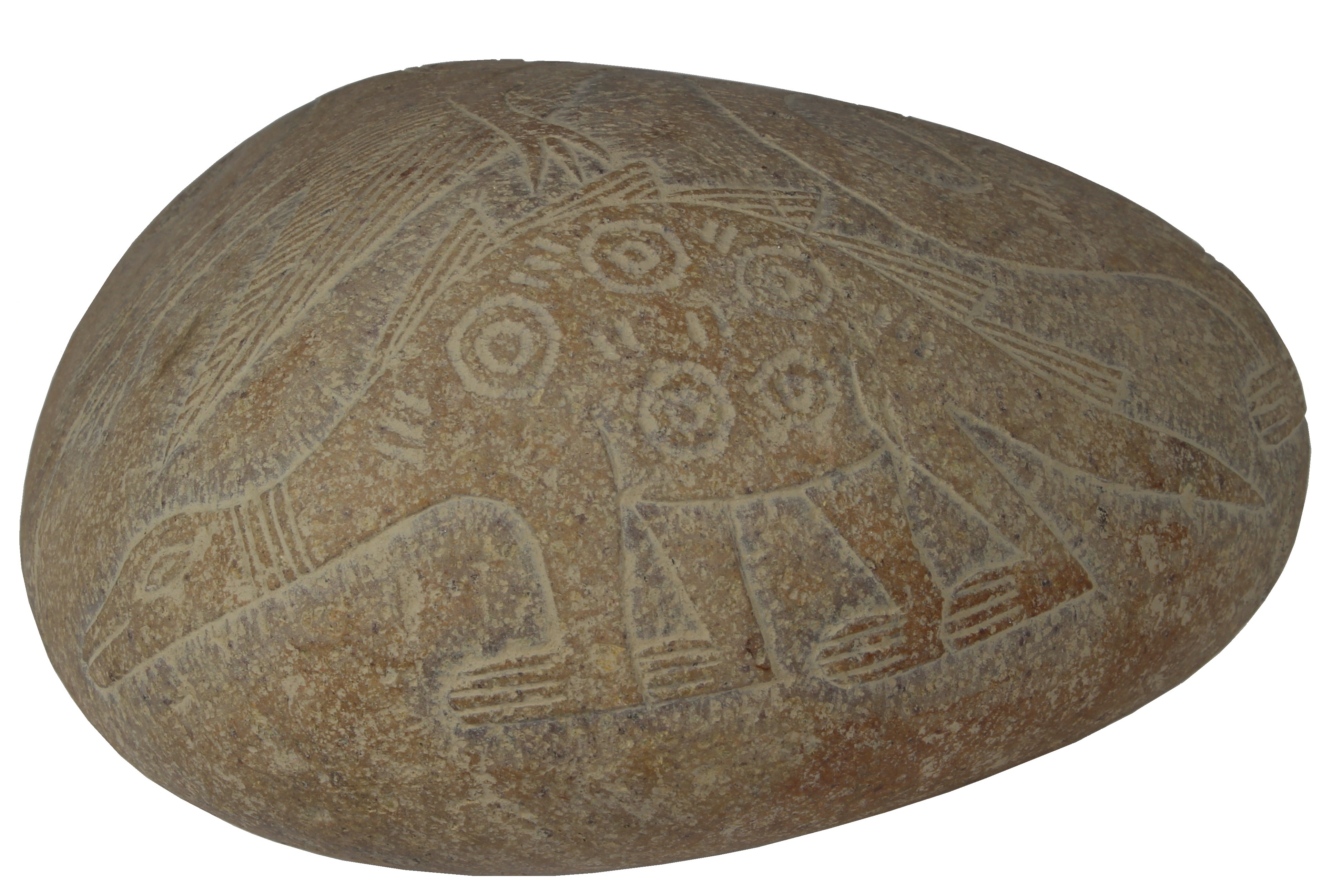 To the left are pictured Ica Ceremonial Burying Stones from the Nasca civilization (100 BC to 800AD) that are carved in a bas relief technique. In 1500s the Spanish Conquistadors brought back stories that there were stones with foreign creatures carved on them constitute in Republic of peru. Some of the stones were even brought back to Spain. The Incan Chronicler Juan de Santa Cruz Pachucuti Lumqui wrote in 1571 about the strange engraved stones in Ica. (Come across Swift, Dennis, Secrets of the Ica Stones, 2006.) Dom Geronomo Cabrera was a Spanish conquistador who settled the area of Ica in 1570. One of his descendants, Dr. Javier Cabrera, saw these stones as a child and began collecting them in the 1960s. He somewhen accumulated thousands of stones. Retired from the University of Lima, Dr. Cabrera focused upon validating these finds within the scientific customs. His credibility was strengthened by the discovery of ancient ceramics that display long-necked, reptilian creatures. This pottery is currently displayed in the museum of Lima (lower right).
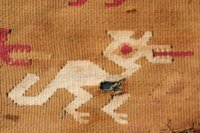
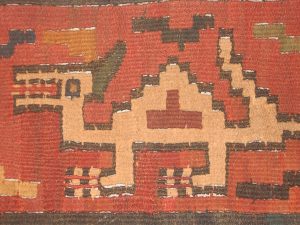
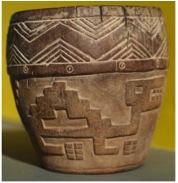
Beautiful tapestries (run across higher up) have also been found in the tombs of the area (dated from 200 – 700 Advertising) with a repeating pattern that looks similar dinosaurs (pictures courtesy of Dennis Swift). Indeed, the depictions on some of the Ica Stones prove the sauropod dinosaurs with a crest of spines much like those on the Acambaro figures, and preserved skin remains discovered by Paleontologist Stephen Czerkas:"Recent discovery of fossilized sauropod (diplodocid) skin impressions reveals a significantly different appearance for these dinosaurs. The fossilized peel demonstrates that a median row of spines was present… Some are quite narrow, and others are broader and more than conical." (Czerkas, "New Expect for Sauropod Dinosaurs," Geology, December, 1992, p. 1,068.)
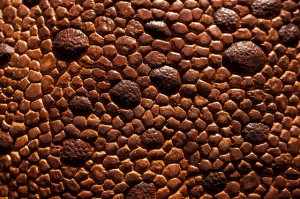
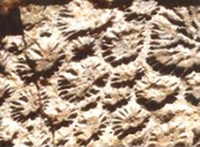
Likewise, of involvement is the fact that the pare of many of the carved dinosaurs has rounded, bump-similar depictions. Some scientists had pointed to this as prove that this rock art is not scientifically authentic. Withal, more recent discoveries of fossilized dinosaur skin and embryos have silenced these same critics. For example, Luis Chiappe and colleagues discussed certain sauropod dinosaur embryos found in S America: "The general skin pattern consists of round, non-overlapping, tubercle-like scales…A rosette pattern of scales is present in PVPH-130″ (Chiappe, et al., 1998, p. 259). Note the skin depictions above to the right. "Both taxa bear witness a round blueprint of small polygonal scales, which in some places is interrupted by larger oval tubercles surrounded by the small scales, resulting in rosette-like structures. …which also friction match the most mutual textures known in dinosaurs." (Christiansen, and Tschopp, "Exceptional Stegosaur Integument Impressions from the Upper Jurassic Morrison Formation of Wyoming," Swiss Journal of Geosciences 103:2, 2010.)
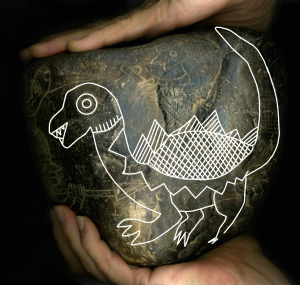
Authenticated Ica Stone (with lines highlighted)
Other items of anatomical accurateness that adjure to the actuality of these Ica Stone depictions include the positioning of the tail and legs. Early critics said the Ica Stones were fakes, in part because their tails were almost all sticking out while walking. Paleontologists in the 1960s were confident that dinosaurs dragged their tails. The paleontologists were incorrect and the Ica Stones were right. 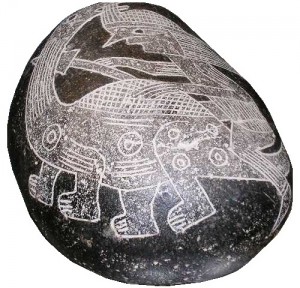 Scientists now believe dinosaurs held their massive tails off the ground while walking, considering there are no drag marks on dinosaur trackways. The dinosaurs on the Ica Stones are accurately depicted standing upright, rather than with legs splayed out in a cadger-like position. The stylizing of animals depicted on the Ica Stones matches those institute in the Nascan Lines (monkey with curled tail, hummingbird, and stylized dinosaur).
 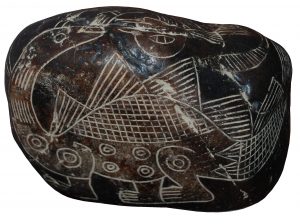 Many of the Ica Stones were been blackened and then that the artistic etchings stand out. Undoubtedly, many fraudulent Ica Stones have been manufactured over the years to sell to tourists. But dinosaur stones were found in tomb excavations by experienced archaeologists. Moreover microscopic analysis of the patina (covering the stone surface), copper traces and oxidation in the etching grooves helps distinguish between the authentic and the recently forged artifacts. In 2015-2016 Genesis Park participated in research seeking a methodology to independently authenticate the Ica Stones. This resulted in an article published in a peer-reviewed cosmos science journal.
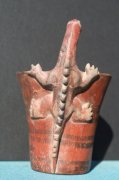
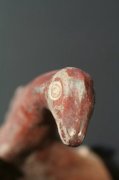
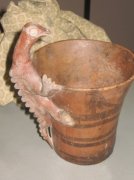
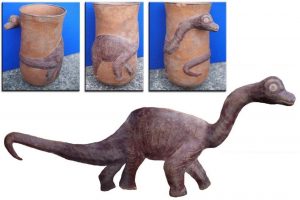
Sauropod dinosaurs accept also been found on ceramics from this same Peruvian region. The Nazcan vases higher up are from Dennis Swift'due south personal collection. These artifacts show a less stylized and very realistic looking dinosaurian with big eyes. One has a dermal frill and the other does not. This may have been a sexual dimorphism (peradventure a gender-specific trait in males). The prototype on the correct manus pot was digitally combined by Richard Dobbs (click to enlarge).
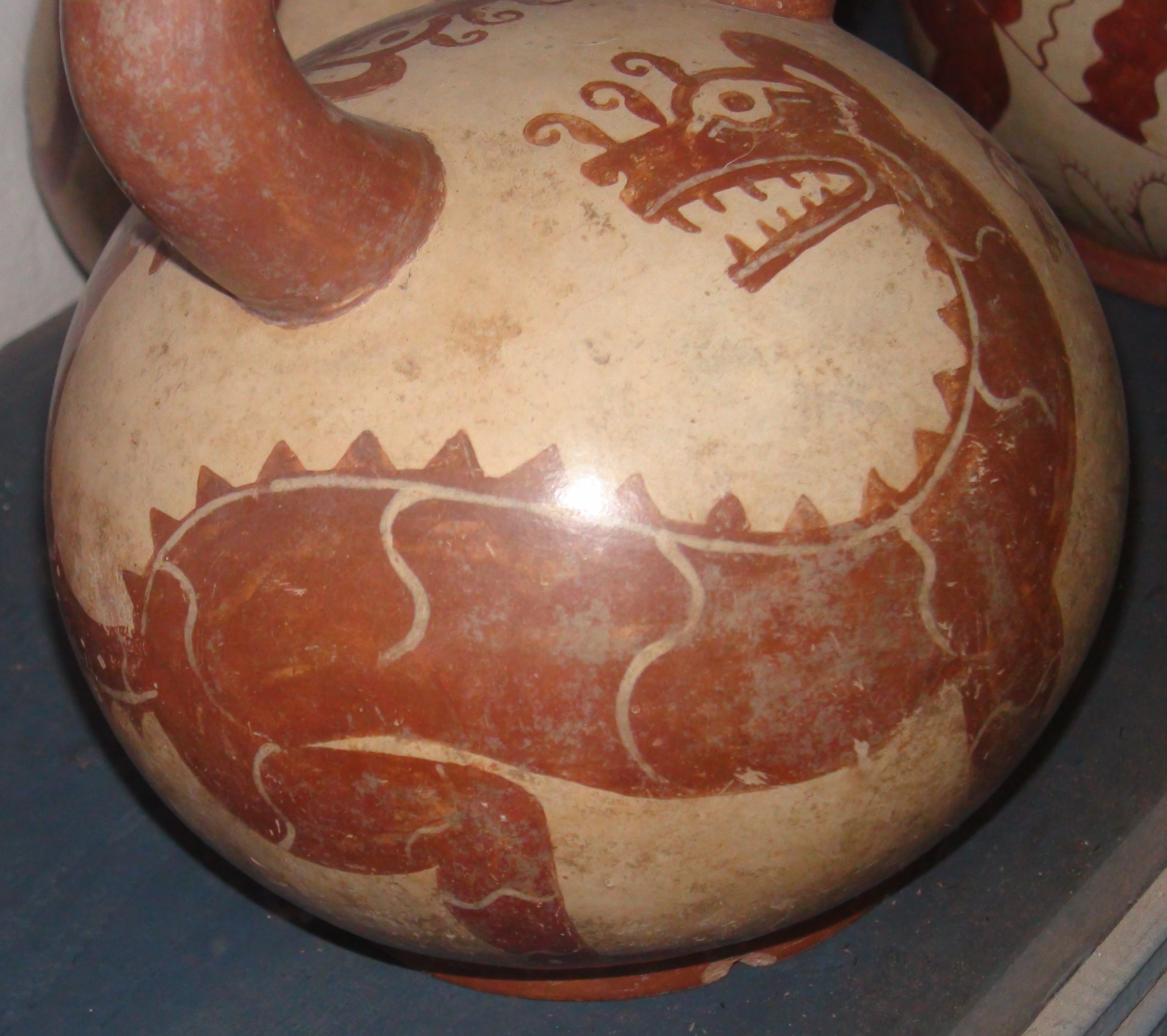
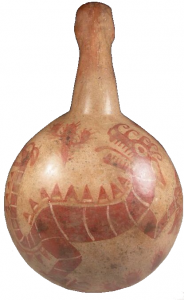
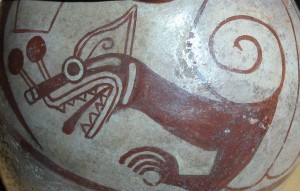
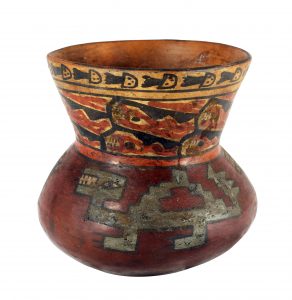
Not far from the South American Nasca sites are the Moche Indian archaeological locations. These Moche tribes inhabited northern Peru about 100-800 Advertising. Among the artifacts currently in the Lima museums are the Moche stirrup-spout pots (left). These are their main artistic medium, featuring red & white ceramic pots displaying realistic medical procedures, combative events, musical instruments, plants and animals. Official guides at Peru'south numerous museums and archaeological sites will tell you that the native cultures depicted only things that they saw in nature. So what inspired the dragon-like images like that on the canchero to the right? In Lima's Larco Museum at that place are numerous ancient vases that quite clearly depict long-necked reptilian monsters with three or iv toes, in some cases carrying a trophy head on their tail. These creatures acquit a resemblance to those shown on the Ica stones, including the dermal frills. They accept been dubbed "Strombus Monsters" because they are sometimes shown hiding in a Strombus crush. (Note the Moche pot on the left. Both this piece and the canchero are office of the Genesis Park collection.)
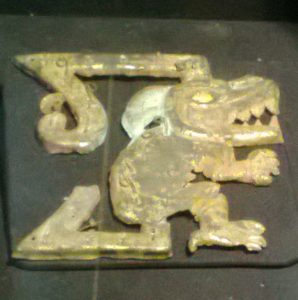
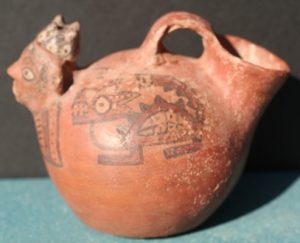
The iii images above are also Peruvian (click to enlarge). To the left is a Moche pot that beautifully depicts a large reptilian course, like to what is shown on many of the burying cloths. In the center is a gold antiquity that resembles a toothy theropod dinosaur. It is housed in the Museo Oro del Peru in Lima. To the right is a Paracas pot that shows a ferocious dinosaurian prototype with a dermal crest going down the trunk and tail.
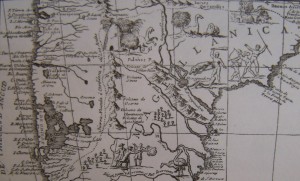 A lexicon (Casamiquela, R.,Diccionario Tehuelche, Va. Adelina: Patagonia Sur Libros, 2008.) on the language of the Patagonian natives (the Tehuelche groups) by the late historian Rodolfo Casamiquela displays a 16 th century map (right). Information technology depicts terrain of the Terra Magellanica (what is now Argentina) and shows a hunting party shooting at a ñandú and also displays some very dinosaurian-looking animals upwardly above. Click to enlarge and expect top center and to the right.
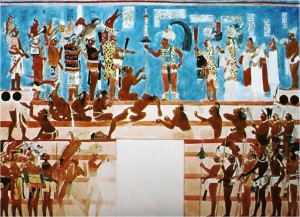
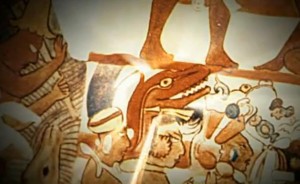 The ancient Maya culture, which flourished around the 6th century, is famous for their excellent artwork. Bonampak is a Maya archaeological site in Mexico where there are a number of wonderful murals, including the remarkable ane to the left. It shows the presentation of various war captives to the ruler, Chaan Muan, along with some trophy heads (perhaps brought for sacrificing). In improver to the human heads, the men are carrying an animal head and what looks a lot like a dinosaur head (enlarged in the picture to the right). Both the teeth and the large size make information technology doubtful that the Maya creative person was depicting a cadger or ophidian.
In 1945 Waldemar Julsrud, a resident of Acambaro, Mexico who had archaeological experience, discovered dirt figurines buried at the human foot of El Toro Mountain. Eventually over 33,000 ceramic and stone figurines were plant! These range from detailed artwork, to whistles and musical instruments, to roughly-shaped animal depictions, to monstrous creatures. There are articulate similarities to Chupicuaro Cultural artifacts(800 BC to 200 AD) found in the area, a culture that Julsrud co-discovered.
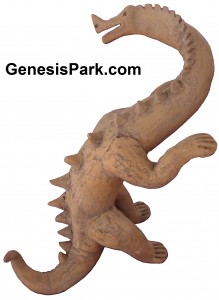
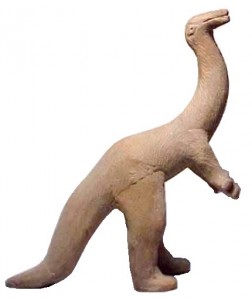
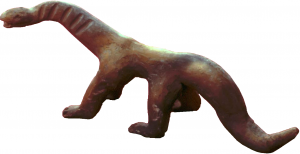
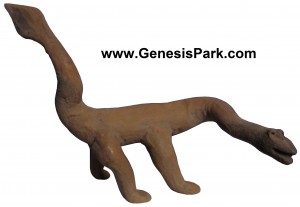 Merely the actuality of Julsrud'southward notice has been challenged because the huge drove included clear dinosaur figurines. In 1954 the Mexican government sent a squad of archaeologists to investigate. In 1955 Charles Hapgood, Professor of Anthropology at the Academy of New Hampshire, conducted an elaborate investigation including radiometric dating and thermo-brilliance testing by the Academy of Pennsylvania. Subsequent investigations were conducted by the Mexican authorities. Thus Julsrud'due south work has undergone considerable scrutiny. The Mexican
 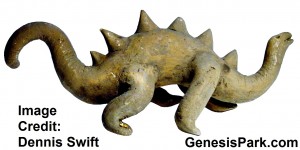 government fifty-fifty imprisoned men for selling these artifacts on the black market. Moreover, the dinosaurs are modeled in very agile, active poses, fitting well with the latest scientific evidence and lending acceptance to the artists having actually observed these creatures. Like the Ica Stones, some sauropod'south are depicted with a distinctive spinal frill. The remains of an ice-age horse (now extinct), the unfossilized skeleton of a woolly mammoth, and a number of ancient human being skulls were found at the same location as the ceramic artifacts, validating the antiquity of the site (Hapgood, Charles,Mystery in Acambaro, 2000, p.82.). Dr. Ivan T. Sanderson was amazed in 1955 to find that at that place was an authentic representation of a Brachiosaurus, almost totally unknown to the general public at that time. Sanderson wrote, "This figurine is a very fine, jet-blackness, polished-looking ware. It is about a foot tall. The point is information technology is an absolutely perfect representation of Brachiosaurus, known only from East Africa and North America. There are a number of outlines of the skeletons in the standard literature but only one fleshed out reconstruction that I have e'er seen. This is exactly like it." (Hapgood, p. 85.)
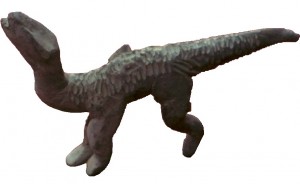
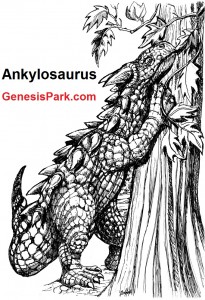
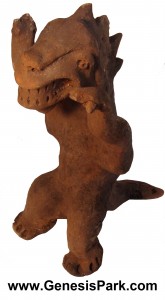
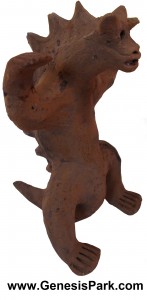
Farther evidence of the authenticity of Julsrud's finds is a figurine that resembles the Iguanodon dinosaur figurine (above left, photo credit – Don Patton). This was one of the first dinosaur skeletons discovered. The early concept of its appearance was almost comical in the mid 1800s. By the turn of the century it had improved considerably just barbarous far curt of what we at present know. The Acambaro figurine exhibits cognition nosotros have gained but in recent decades. No hoaxer could have made this model in the 1940s. In fact, there is a motion in recent years to "slenderize" the sauropod dinosaurs, suggesting that they were more agile and less plump (much like the Acambaro figures). For example, inorth 2009 scientists "devised a new statistical model that tin can more accurately predict the mass of an animal based on the width of its bones" resulting in a downsizing of Apatosaurus, which had "been widely cited as weighing about 42 tons. According to the new equation, these creatures really weighed about 20 tons, or less than half earlier estimates." (Moskowitz, Clara, "Behemothic Dinosaurs Get Downsized," Live Science, Dec 12, 2009.)Other recognizable Acamabaro shown above include figures are the Tyrannosauru south-like theropod figurine and the Ankylosaurus statue. The neb on this figurine is slightly broken off, merely the distinct horns, short neck, dermal spikes, butterball feet and powerful tail are all nicely replicated. (Both of these pieces are in the Genesis Park collection.) Genesis Park staff participated in research on Mount Toro in Acambaro where most of these artifacts accept been excavated. Many figurines remain buried in the footing there and new pieces are regularly being exposed as a result of erosion, structure work, and farming.
 To the left is an artifact from Tiwanaku, an important Pre-Columbian archaeological site in Bolivia. Tiwanaku is recognized by Andean scholars as ane of the most of import precursors to the Inca Empire. The vase depicts dueling dinosaurs and is believed to date from 500 – thou A.D. The style closely resembles the Nasca dinosaurian depictions (on the Ica Stones).
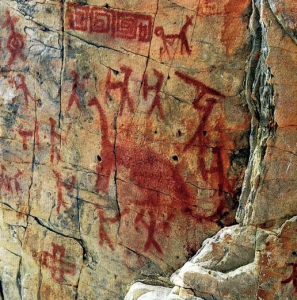
In May of 2012 researcher Vance Nelson brought to our attention a panel of pictographs found on a rock ledge at the border of the Amazon rain forest bowl nigh Yamon in the northern province of Utcabamba, Perú. This artwork is said by secular archaeologists to exist thousands of years old. Amazingly, one of the pictographs shows nine warriors hunting what appears to exist a dinosaur. In the 1940s the American explorer Percy Fawcett brought back reports of a big dinosaur-like creature from this aforementioned region of the Amazon.
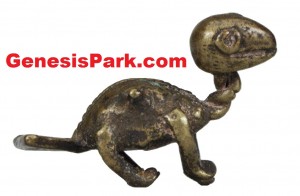
The Ashanti people of Ghana in western Africa are known for their statuary carvings that were used over the centuries as gilded weights (used along with a scale in the gilded dust trade). Eventually, these little statues became a chip of an art class and many accurately depict various African animals. The curious gold weight to the left dates back to the 1800s and is now part of the Penn Museum collection in Philadelphia (Image #AF2478 deputed by Genesis Park). It was unidentified initially, "despite diligent search in the brute kingdom." (Plass, Margaret, African Miniatures: The Goldweights of the Ashanti, 1967, p.92.) A jeweler in Philadelphia commencement suggested that it resembles a juvenile dinosaur. (Heuvelmans, Bernard, Les Derniers Dragons d'Afrique, 1978, pp. 336–337.) It has a fan tail and a nib-similar oral fissure, distinctive characteristics of some of the recently-discovered oviraptorosaur fossils.
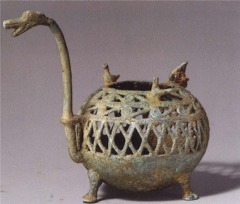
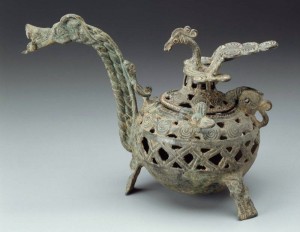
To the left is an ancient Thai incense burner pictured in the book Arts of Asia : Materials, Techniques, Styles by Meher McArthur. Curiously enough, it looks like a stylized version of a sauropod, the fossilized bones of which were actually found in Thailand. Find the birds perched on the dorsum of the dragon, much equally we see them practise today on the back of a hippo. A similar motif is seen in a Viet incense burner to the correct. This cast bronze piece of work is dated to the 3rd century A.D. and is from the Dongson culture. The piece is housed at the Boston Museum of Fine Arts.
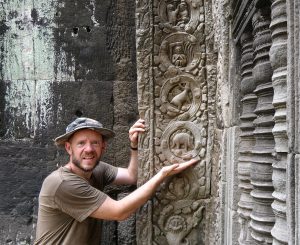
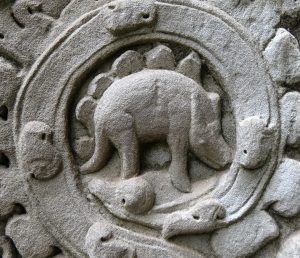
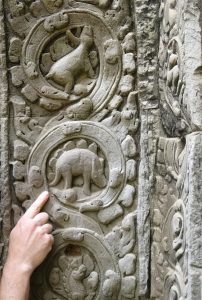
Deep in the jungles of Cambodia are ornate temples and palaces from the Khmer culture. One such temple, Ta Prohm, abounds with stone statues and relief fine art. Almost every foursquare inch of the gray sandstone is covered with detailed carvings. These describe familiar animals like monkeys, deer, horses, elephants, water buffalo, parrots, and lizards. However, one column contains an intricate carving of a stegosaur-like creature. Notation the upright posture, huge tail, and plates (lower left). Merely how could artisans decorating an 800 yr sometime Buddhist temple know what a dinosaur looked like when western scientific discipline simply began assembling dinosaurs skeletons in the past 2 centuries? It seems that the Khmer artist had seen or received reports of a stegosaur. However, skeptics point to the lack of tail spikes and the over-sized caput to question the stegosaur interpretation. Afterward traveling to Ta Prohm in 2017, taking hi-res photos and measurements, and discovering a second stegosaur engraving, Genes Park staff prepared a peer-reviewed periodical commodity on "The Stegosaur Engravings at Ta Prohm" responding to the critics.
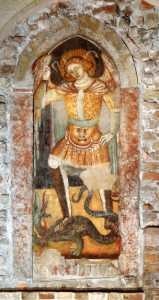 Medieval European art is replete with dragon iconography, much of it used to typify Satanic power (Revelation 12:3). A wonderfully-preserved fresco (on the left – click to enlarge the dragon) depicting the archangel Michael overcoming the dragon is displayed at San Zan Degolà, a beautiful little 13th century church building in Venice, Italy. The dragon'due south proportions and particularly its atomic forepart legs bring to mind the pocket-size theropod dinosaurs like Compsognathus.
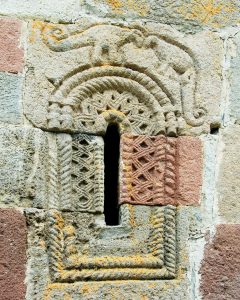 The country of Georgia sits at the border of Eastern Europe and Western Asia. Loftier in the hills atop Mount Gergeti is the Holy Trinity Church (also known as Tsminda Sameba) which was originally constructed in the 1300s. The bell tower window (shown on correct) contains some unusual carvings that look quite a bit like two dinosaurs, perhaps engaged in caput-butting combat. Within the church is an ancient icon of St. George slaying a serpent-like dragon. St. George has been revered in the Commonwealth of Georgia since the 4th century. The weathering and patina of these dragons certainly seems to friction match the remainder of the construction, suggesting it is an original carving.
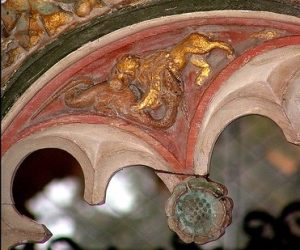
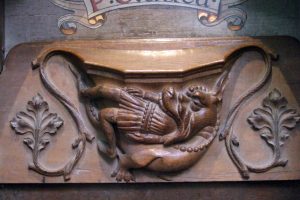
Choir stall railings and misericords (shelf-like seats for reclining while standing) in Medieval European churches are oftentimes adorned with ornate carvings. A mutual theme is the depictions of a dragon (symbolizing Satan) fighting a lion (symbolizing Christ). Lower left is ane such delineation, showing a dragon that looks very much like a sauropod dinosaur, taken from St. Remigius' Church. Other dragon scenes are also depicted. Notice the dragon eating a man as shown on a misericord from St. David'due south Cathedral in Wales. The Carlisle Cathedral's misericords showing twin dragons were carved in the 15th century. Click to overstate these pictures.
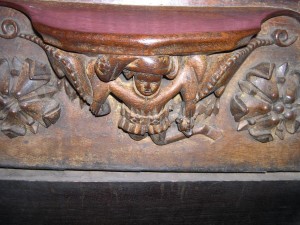
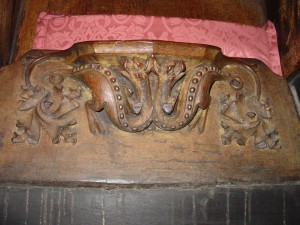
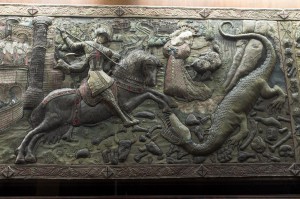
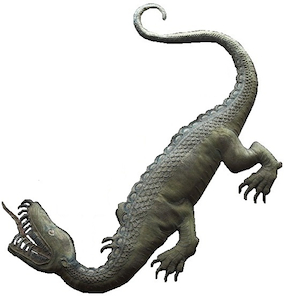
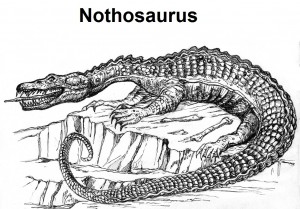
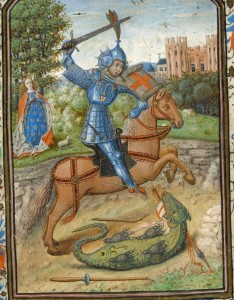
The slaying of a ferocious dragon by St. George is an extremely mutual motif in medieval art. Various European artists interpreted the dragon differently, depending on local knowledge and lore. A wonderful medieval depiction is seen at the Palau de La Generalitat in Barcelona Spain. St. George's Chapel contains an altar cloth illustrating St. George'due south slaying of a dragon. The delineation bears an amazing likeness to the Nothosaurus, a semi-aquatic reptile (comparison below). Find the correct-size, the crocodilian body style, and the fascinating long, curved teeth at the front of the jaw that gives way to effectively dentition towards the dorsum.
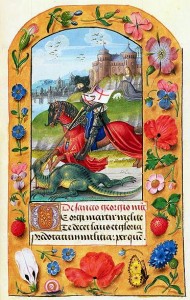
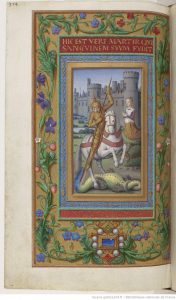
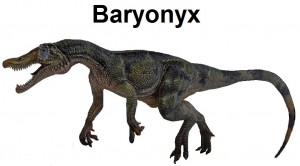
Yet another interpretation of St. George slaying the dragon is found in the Latin Volume of Hours c. 1450 Advertisement which is illuminated by the Principal of Jean Chevrot and currently housed at the Morgan Library & Museum (lower left). Notice the Master's attention to detail (click to overstate), as seen in George's armor, the birds in the sky, and the dragon's genitals. The Fitzwilliam Museum contains another portrayal (lower middle left) of St. George destroying the dragon (probably by Bruges) from a Latin Book of Hours c. 1490 AD. This colorful work from the Flemish School portrays a remarkably dinosaur-like dragon. Next we present (below middle right) an illustration of George leading a defeated dragon as seen in the book Huth Hours, published in the Netherlands c. 1480 (Image from the British Library). The monster has a curiously large stomach (possibly gravid) and is web-footed. But notation the accurate reptilian ear and dinosaurian cervix. Finally, below on the right is a portrayal of St George from the early 1500s courtesy of the Bibliothèque Nationale de France. The dragon'southward head is rather flattened, like the snout of the baryonyx dinosaur seen below.
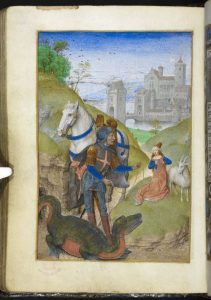
Below to the left is yet another artistic variation of the event of St. George slaying the dragon. Here we see the famed knight of Cappadocia lancing a slender 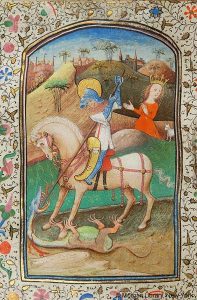 reptile featuring a prominent, long neck. What would have inspired an artist from Bruges, Belgium in the year 1440 to brandish the dragon in this painting with such a long neck? It doesn't resemble any common reptiles that he would have known, like a cadger or crocodile. But information technology does wait very much like sure kinds dinosaurs (similar a juvenile Diplodocus or the pocket-size reptile Tanystropheus).
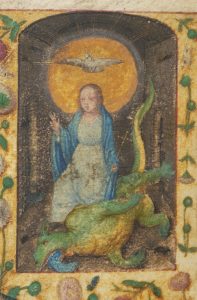 Another popular Medieval dragon legend involves Saint Margaret of Antioch. Stories of this young Christian martyr vary. Supposedly she lived in the quaternary century AD and encountered extensive persecution for becoming a Christian. At 1 point, she was fifty-fifty attacked by a dragon, which swallowed her whole. But as she began to pray inside the reptile, the cantankerous she wore effectually her neck cut into the stomach of the reptile sufficiently that she was able to pop back exterior, killing the dragon. Diverse creative images of this event reverberate the local conceptions of dragons. Find the dinosaurian features (right) in this illustration by a Belgian artist for a Book of Hours that is currently in New York's Morgan Museum.
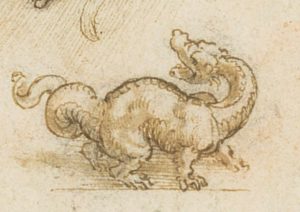 The famous Italian artist Leonardo Da Vinci was gifted in working various mediums. A pen and ink picture entitled "Cats, Lions, and a Dragon" was fatigued past him circa 1517–1518. It is now office of the Regal Collection housed at Buckingham Palace. The cats are all drawn with the incredible realism and item that comes from personal observation. The single dragon bears a remarkable likeness to a small-scale sauropod dinosaur. But dinosaurs would non be discovered in Europe for another iii centuries! What did Leonardo base of operations his dragon drawing on? The only odd feature is the coiled tail. In that location is an artist's annotation at the bottom of the cartoon: "Of Flexion and Extension". Perhaps at that place was a species of small sauropod known in the Eye Ages that could coil its tail. Or peradventure the unusual tail posture was based upon reports of common lizards that tin can curlicue their tail and use information technology for grasping.
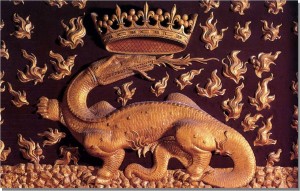
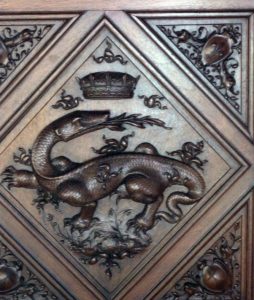
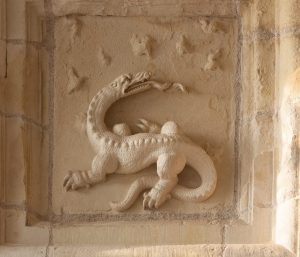
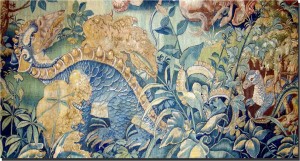
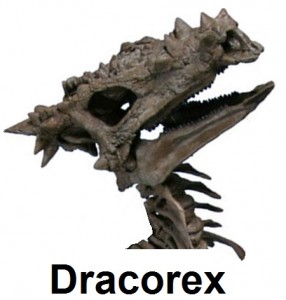
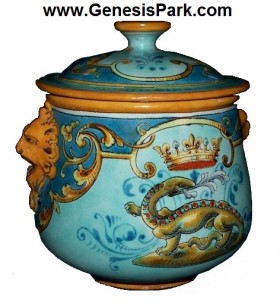
Some of the beautiful French chateaus built at the shut of the Middle Ages and early 1500s have dramatic dragon illustrations carved into their walls, ceilings, and furniture. These include Château de Chambord, Château de Blois, and Château Azay-le-Rideau. Called "salamanders," based on a legendary salamander that could survive fire, they became especially pop decorative elements on construction during the reign of Francis I. Often they are portrayed really every bit a fire-animate dragon, like the biblical Leviathan. A number of features make these "salamanders" different from the amphibians we know by that proper noun today. They are depicted with long necks, scales, prominent teeth, powerful claws, and an upright posture. The class is much closer to the reptilian dragon depictions common in European art from that period. Note the similarities among these "salamander" dragons below and their resemblance to dinosaurs similar Thecodontosaurus, Plateosaurus or Baryonyx (whose fossils are found in multiple locations around Europe). A number of royal household effects from that time also depict a like dragon, like the antique French pot below to the right. A tapestry at Château de Blois portrays a dragon (and its babe) with gnarly horns on its head that are reminiscent of the dinosaur Dracorex hogwartsia. [Photo credit: Don Patton.]
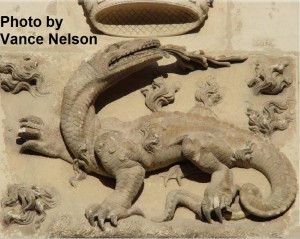
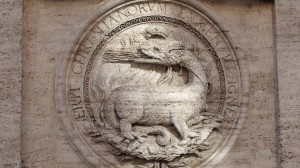
In Rome there is similar artwork on the outside at the Church of St. Louis of the French. This served for many years as the national church of France in Rome and was completed in the 1580s. Notice on the dragon artwork (to the left) the long neck, tridactyl anxiety, long tail, cervix frill, the scales, and especially the dinosaurian-looking legs. They drop downwards straight, rather than being splayed out parallel to the basis similar a salamander or lizard's legs. Though exposed to the elements on the exterior of the church building, the detailed piece of work has been remarkably well preserved over nearly five centuries! Click to enlarge this amazing dragon carving.
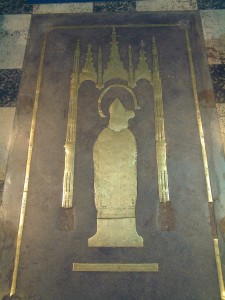
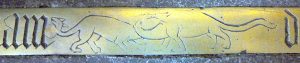 In 1496 the Bishop of Carlisle, Richard Bong, was buried in Carlisle Cathedral in far northern England, near the Scottish border. The tomb (run into far correct) is inlaid with brass, having various animals engraved upon information technology. Although worn by the endless feet that walked over information technology since the Middle Ages, a particular depiction is intriguing in its similarity to a sauropod dinosaur. Information technology appears to be two long-necked dinosaurs with necks entangled like the Egyptian Hierakonpolis dragon depictions mentioned above (peradventure an dotty posture). The long tails stick out straight like an Apatosaurus and of one (perhaps the male) sports spikes at the finish. Amongst the birds, canis familiaris, eel, bat, play tricks, etc. depicted around the tomb, this compelling representation of 2 long-necked creatures should be considered evidence that man and dinosaurs co-existed.
Source: https://www.genesispark.com/exhibits/evidence/historical/ancient/dinosaur/
0 Response to "Egyptian Art 2 Sided Figurine With Woman on One Side and Man on the Back Side"
Post a Comment