Blanton Sarah Scaturro Head Conservator the Costume Institute Metropolitan Museum of Art
A Silent Roundtable Word
on Disability and Inclusion in Art Conservation
Art conservation is a field defended to preserving art and historic artifacts for current and future generations. It is currently skillful by professionals with noesis and skills in artistic practice, scientific discipline, and the history of art and culture. In many countries, including the The states and Canada, art conservators are trained in two-to-4-year graduate programs. The grooming and subsequent work often requires incredible stamina, well-developed fine and gross motor skills, and the power to come across very fine detail.
We convened a roundtable to provide a platform for thoughts about inability, accessibility, and fine art conservation. Three fine art conservators, each with different personal and professional experiences with disability, gathered to discuss the thought prompts beneath. The discussion took place in a Google document, with no reliance on the audible voice. A condensed version is below. We explored how the art conservation profession is enriched and strengthened by accommodating practitioners with a broad variety of abilities.
(Note: There are numerous words and phrases used to refer to people who do or do not take disabilities. In this one discussion you will find more than nine. The words used are the electric current preferences of those using them. The preferences do not reflect the preferences of the entire disabled community.)
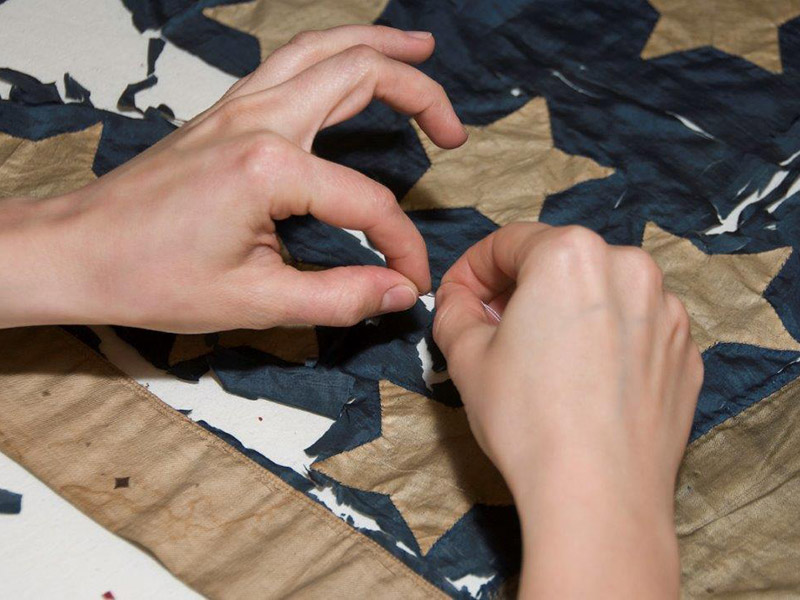
Fine motor skills at work as Joelle Wickens tackles the challenge of stabilizing a shattered silk flag, the Us National Flag, attributed to Clarissa Wilson, and in the intendance of the Betsy Ross Business firm. (Image credit: William Donnelly)
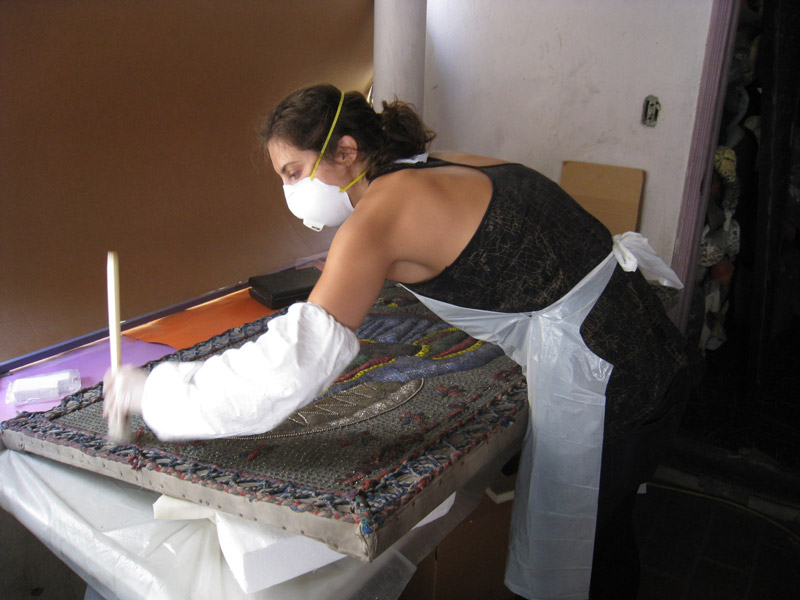
Sarah Scaturro surface cleaning a sequined flag from the Marianne Lehmann Vodou Drove as role of the Smithsonian Institution'due south Haiti Cultural Recovery Project in 2011. (Image credit: Haiti Recovery Project Squad)
Please share a chip nigh yourself, your path in conservation, and your electric current office.
Wickens: I am the Associate Manager of the Winterthur/University of Delaware Programme in Fine art Conservation (WUDPAC) and an Assistant Professor of Preventive Conservation in the Art Conservation Department at the Academy of Delaware. I teach art conservation graduate students, and am responsible for guiding all aspects of the WUDPAC program. I co-pb a project called Advancing Equity and Inclusion in Conservation that's focused on working with conservation leaders as well as early career conservators from underrepresented communities to identify and create paths to a more than inclusive field. We are examining past and current projects that accept tried to increase diversity in the field, determining whether these projects accept achieved their intended affect, and plan to utilize the lessons learned to shape futurity efforts.
I earned a master's degree in textile conservation from the Academy of Southampton in 2003, and a PhD in the conservation of 20th century foam-upholstered article of furniture from the aforementioned institution in 2008.
I started my training equally a conservator in 2001, 2 ½ years later I was diagnosed with Multiple Sclerosis. At that betoken, my disability was invisible. In the nineteen years that I have been in the field my affliction has progressed, and for the last seven years, I accept relied on a wheelchair to move around when I am outside of my home.
Kim: I am currently a postgraduate swain in object conservation at Williamstown Art Conservation Center. Here, I work on a wide range of three-dimensional objects and, occasionally, do scientific analysis of materials. One of my research projects is investigating the crumbling properties of the materials used by a mixed media creative person from the 1980s.
Prior to coming to the field of art conservation, I double-majored in concrete chemical science and visual art at Brownish University. I did not know nigh fine art conservation until I was nearing my senior year. So, by the time I graduated, I had not taken plenty art history classes to apply to conservation programs. I briefly went to Institut Catholique de Paris to study art history, thinking I'd put my French skills into exercise. So, I enrolled in a graduate fine art conservation plan at Queen's University in Canada. I interned at the McCord Museum in Montreal and the Museum of Anthropology in Vancouver, and then finished my studies in 2019. I did non expect to exist back in the Usa and then soon!
I have a severe hearing loss, then I wear a cochlear implant audio processor with hearing assist. According to my audiologist, I cannot hear well because my cochlear is "very naked without pilus." I rely heavily on lip-reading to communicate. Of course, it's not helpful in our era of masks.
Scaturro: In April, and during the pandemic, I started a new position as the Eric and Jane Nord Chief Conservator at the Cleveland Museum of Fine art. Formerly, I was the Head Conservator at the Metropolitan Museum of Art's Costume Found, and prior to that I was the Textile Conservator and Assistant Fashion Curator at the Cooper-Hewitt, Smithsonian Design Museum. I received my training from the Fashion Institute of Technology, specializing in textile and mode conservation and curation. I've too simply picked upwards my MPhil from Bard Graduate Center and am on the style towards earning my doctoral caste in design history and cloth culture studies. I'm writing my dissertation on the development of costume conservation in Northward America and Uk during the second half of the 20th century, concentrating on the shift that occurred when conservators stopped entering the field primarily through apprenticeships and instead were required to have a postgraduate caste. My studies and my amazing apprenticeship-trained mentors have taught me to exist more open up about who I await for when hiring a conservator. I believe that inbound the field through an apprenticeship is nevertheless valid, and hopefully also has positive implications for accessibility and diversity. I personally lucked into the conservation field: I didn't find out most information technology until my late twenties. When I realized there was a field that combined art, science, craft and history, my mind exploded. Luckily, I went to a public university (FIT) with less competitive admissions, that didn't crave the usual crazy hours of internships, and that happened to be ane of the few schools in the earth focusing on fabric conservation.
Describe your agreement of and/or thoughts and feelings about the word inability and your personal experience with information technology.
Kim: Allow's start with a brief etymology, which is admittedly a bit contested. Currently, we use the term "inability" because "handicap" is considered politically incorrect. According to a mutual myth, the word "handicapped" originated in the U.k. under Male monarch Henry VII's reign in the sixteenth century, when veterans became disabled and, unable to discover jobs, resorted to begging on streets with "cap-in-hand".i In the Oxford English Dictionary, we learn the earliest use of the term was in a British betting game in 1653.2 In the nineteenth century, the term was commonly used in sports games to describe an act of making games fair by putting skilled competitors at a disadvantage, a do that continues in golf today.
"Handicap" was used in conjunction with inability for the first time in 1915, to categorize physically disabled children, and more widely used in 1958 to depict all disabled persons, whether children or adults, and whether physically or mentally disabled, or both.iii
Historically, disabled people have been seen as a liability. They were often segregated, forcibly sterilized, institutionalized, or sent to labs: not only in Nazi Germany but besides in the U.s. and Canada. The forced sterilization of disabled people connected in the U.s.a. until 1979,4 even after the 1964 Civil Rights Human action: the Supreme Court ruled that forced sterilization of the disabled people did not violate the US Constitution.5 Supreme Court Justice Oliver Wendell Holmes, Jr. even in one case infamously stated: "It is amend for all the world, if instead of waiting to execute degenerate offspring for law-breaking… society tin can prevent those who are evidently unfit from continuing their kind… Three generations of imbeciles is enough".6
The 1990 Americans with Disabilities Human action (ADA) formally granted some ceremonious rights to the disabled in the United states.7 In 1992, it was expanded to be known every bit "an equal opportunity constabulary", and recognized the need for accommodations and services in public and private sectors (east.k. transportation services). Access to electronic information technology became a law in 2010 with the Communications and Video Accessibility Act (CVAA), the twelvemonth I entered my college!8
Scaturro: I didn't realize that there was a police for electronic it! That shows just how ignorant we are (I am).
Kim: When I started higher, the manager of pupil accessibility services introduced me to CVAA, and told me what my rights on campus were. I looked at her really amazed and confused, as in, await, does the Communications Access Realtime Translation (CART) service yous are talking about actually exist?
When I look at the history of disability in the Usa and Canada, I am both horrified and relieved. I feel privileged to have been given many opportunities in higher didactics and the workplace. Unfortunately, even though at that place are laws protecting our civil rights, many people are not enlightened of their existence, and we accept to constantly advocate for the bones access we are supposed to be guaranteed. Our nobility and rights as human being beings have come a long manner and there is still a long route ahead.
Wickens: Sally, thank you for sharing all of this history. I knew $.25 and pieces of it but having this fuller story is empowering. For me, I have never felt comfortable with the give-and-take "disability," and I have some of the aforementioned feelings about "differently-abled." I observe that both words seem to indicate that there is something else that is amend. To me, we are all differently abled. We are taller, shorter, with louder and softer voices, with precise or imprecise fine motor skills, with the ability to jump high or not jump at all. Some can see far or close; some are colorblind.
Scaturro: Yeah, thanks, Sally. For me, I have some hearing loss that has been partially corrected through surgery. I rely on lip-reading to analyze my understanding of what I'yard hearing, which I only found out in my twenties! I don't feel comfortable calling myself disabled, which speaks to how charged the term is, as some people use the word "inability" to reclaim it, whereas other avoid it. I don't really tell people virtually my hearing loss. It's not visible, and doesn't really seem to bear upon me, so why bring it up? I prefer the term differently abled.
Kim: I grew upwardly with hearing loss and never went to Deaf communities or schools for the deaf, so I have e'er been aware of how unlike I was from my classmates.ix I was so constantly frustrated that I decided that if I were to continue my studies in higher-education, I would go to schools where accessibility services are provided.
How has inability had an bear upon on your conservation career?
Kim: The main upside to being hard-of-hearing is that I am good at immersing myself in treatments. No sound will carp me. That is why I tend to be quicker than expected when doing delicate treatments: for example, stabilizing all wefts in a three-dimensional textile object, or carving a large epoxy fill up to imitate the scrollwork on a Rocaille frame. In one case, I was so focused on applying a lacquer coating on a bronze sculpture that I did not notice a ringing fire alarm until I was done and saw people running in the hallway! Thankfully, my colleagues noticed the issue and immediately installed visual fire alarms in different areas of the edifice.
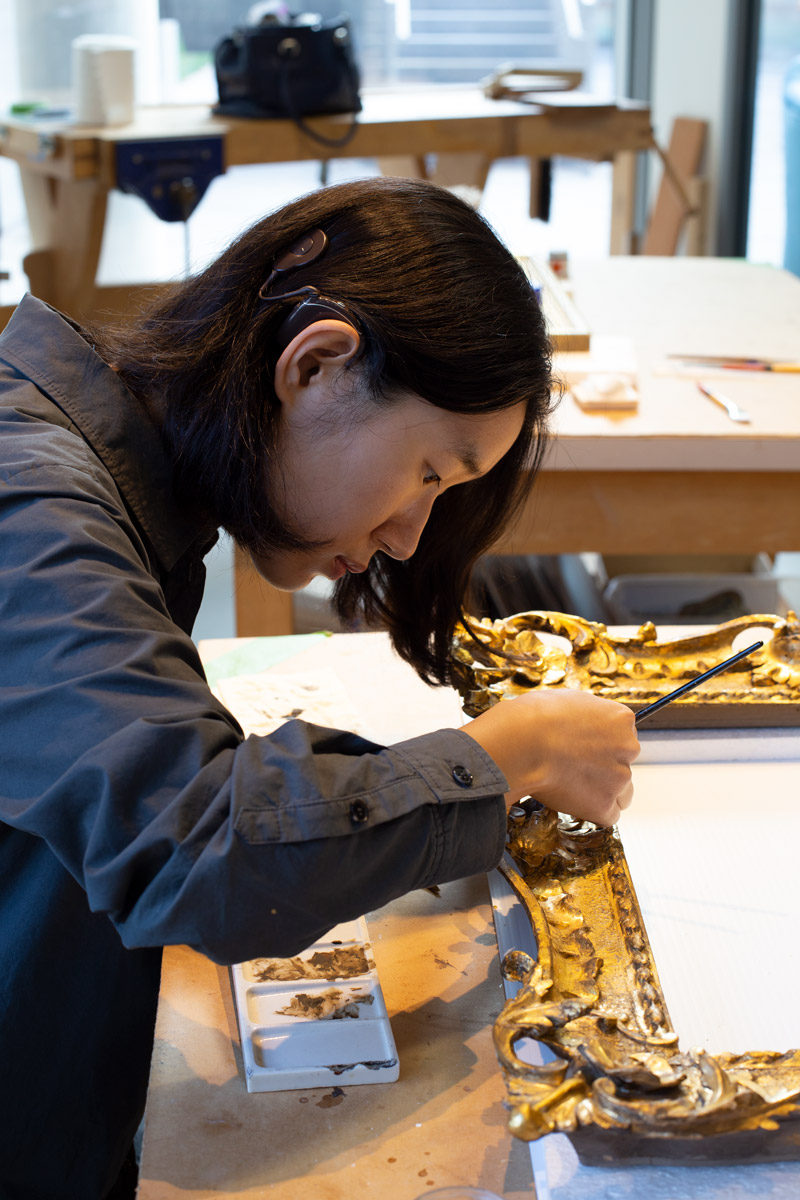
Emerge G. Kim inpainting the reconstructed fills to integrate with the original gilding in the Rocaille frame. She is wearing a Cochlear™ Nucleus®7 Audio Processor (dark brown) on her right ear. (Prototype credit: Matthew Hamilton)
There are some downsides. There are many webinars, lectures, or workshops that I wish to attend, simply it is not like shooting fish in a barrel to understand the context or participate in discussions if closed captioning is non provided. Job hunting is likewise a challenge. Many interviewers take been understanding of my situation, and either met me in-person or talked via video calls so that I could read their lips, but information technology is frustrating when only phone calls are accepted. Lastly, masks being worn during the pandemic take made it challenging for me to communicate at work. My colleagues have been very understanding, which I appreciate.
Wickens: My disability has had a significant impact on my conservation career. It is actually the progression of my disability from invisible to visible, and the subsequent impact on my fine motor skills also as my ability to motility large objects and climb stairs, that encouraged me to move away from fabric conservation and into preventive conservation. I loved textile conservation. I loved what could be hours on end of stitching tiny stitches with invisible thread. Now I have found that I love preventive conservation fifty-fifty more. Caring for things earlier they fall apart seems so much more sustainable to me, and there is so much preventive conservation that everyone tin do. I feel preventive conservation helps me empower others to care for their own cultural heritage, and it allows me to practice my craft with the current abilities of my body.
At that place is very little preventive conservation that I practice that involves sitting or standing in front of an object working on it, a part of the job conservators call working at "the bench." The American Found for Conservation (AIC) defines conservation as "all those actions taken toward the long-term preservation of cultural heritage."10 There are and then many things that nosotros exercise to conserve objects that don't take place at the bench: these tasks are mayhap more attainable for those with a variety of physical limitations.
Scaturro: Yes, I don't think it'south just bench work that makes the conservator. As I've progressed in my career and gotten further and further away from the bench, I've become very self-witting about non actually having a bench exercise anymore. I practise experience that some in our field are judgmental nigh this.
Kim: When I first started my graduate program in art conservation, I thought the task only involved benchwork. All the same, equally you've pointed out, we are involved in many aspects of collections care. Ane of my responsibilities is emergency preparedness and response planning. I was surprised by how many emergency plans lack back-up plans in case we have at least one disabled colleague.
What tin can the conservation community do to get more than inclusive of the disabled customs?
Scaturro: As someone who hires and manages people, it'south my responsibility to exist open and welcoming, and to care for my team. I believe in finding means to craft roles that work for everyone on my team. All of my employees are dissimilar and crave a unique and considered approach.
Kim: I have a question virtually hiring and managing people. Are people often forthcoming with what they need in order to exist able to contribute well to your team? According to the ADA, employers are "prohibited from asking questions that are likely to reveal the existence of a inability earlier making a job offer."11
Scaturro: Some people have been forthcoming. It certainly matters if their disability is visible or not. One person I hired was extremely forthcoming about their disability, and it was visible. I took that into consideration when setting the parameters of their tasks, but never asked them explicitly about it unless it seemed appropriate. I figured they had handled their inability all their life, could do the job at hand, and knew when they needed something. I too accept had a team member who I believe has pretty significant hearing loss, but they never once mentioned it to me, and I noticed in part considering I'm hypersensitive to my own hearing issues. I never brought it upward, but I made sure I modulated my speech and selected the environment so that they defenseless everything.
Wickens: In that location are so many things we tin do to be more inclusive, and we are considering this at the University of Delaware correct now. Then many of our conservation labs are inaccessible to me because I utilise a wheelchair. Too, we run many public tours through the labs. If others with limited mobility come across that they can't even access the labs on those tours, how are we going to convince them that conservation is a career for them?
Scaturro: I hold, Joelle. A former intern of mine who is paralyzed on ane side is notwithstanding considering whether or not to enter the field. They fright they won't be welcomed or even considered. What am I to say? I hired this person, and I believe they can develop the skills to flourish in the field. I also desire to believe in the good will of our colleagues. Merely how exercise nosotros become more welcoming equally a profession?
Wickens: I retrieve we need to observe a way for people to be open about many levels of disability/ability. Non beingness able to utilise your arm should non limit yous from existence part of caring for cultural heritage. If we wanted to bring your previous intern through our current preparation programs, nosotros'd take a lot of work to do to accommodate them. Notwithstanding, we are beginning to think nigh different training pathways. Maybe there are different methods of training, combined with a broader definition of what conservation is, that can help those with a range of abilities get into conservation.
Another matter we need to consider—in conservation graduate school and across—is the number of hours we expect people to piece of work. We should all be taking intendance of our mental and physical health while we study and/or work. If the expectation in the field is that you volition give inordinate amounts of fourth dimension to work, leaving little or no time to care for yourself, conservation will non exist welcoming to those with mental and physical wellness issues. I retrieve this is something many US professions need to consider, not just conservation. The expectation of long, long hours makes certain careers inaccessible, and usually the long hours are non actually necessary.
How are the barriers to inclusion in conservation for disabled people like or different to those of other underrepresented groups in conservation?
Wickens: Right at present white, non-disabled, eye to upper course people with a graduate level caste boss the field. If yous are outside this dominant group, there are many factors at piece of work in keeping you out. If y'all are a member of more than one underrepresented grouping so the factors but multiply.
My clarification of the dominant group is based on the demographics in AICs 2014 salary survey12, and my personal feel at national and international conferences, and equally a graduate school admissions committee fellow member. It may non be 100% correct, but it is close. For our chat, tin we agree it is sufficient?
Scaturro: I agree. The field is besides largely women.
Wickens: And then then some of the underrepresented groups in conservation are the disabled, anyone who identifies with a non-white race, LGBTQ+, lower income, and probably immigrants, first generation higher graduates, and people who practice religions other than Christianity.
If we consider these groups from a different angle, we can think about visible and invisible identities. Some visible identities are race, some disabilities, and religious exercise that requires specific wearing apparel. Some invisible identities may be income level, LGBTQ+ status, and family didactics history. Again, these comparisons are not exhaustive simply they provide a lens through which we can examine barriers.
Kim: I interesting thing I heard from my colleagues is that they said, "We accept non seen an art conservator who is PWD (Persons with Disabilities) every bit a face on AIC." I think media representation is important. But, non all PWD are visibly disabled.
Wickens: And some may wish to hide their disabilities in images.
I used to like it when my wheelchair was non visible in an image. I didn't want to exist defined past my wheelchair and I felt like it was the but thing people saw in an image. Merely I'm realizing having my wheelchair visible may be an of import factor in advocating for PWD, and that lack of visible representation is definitely a barrier to making a field welcoming to all.
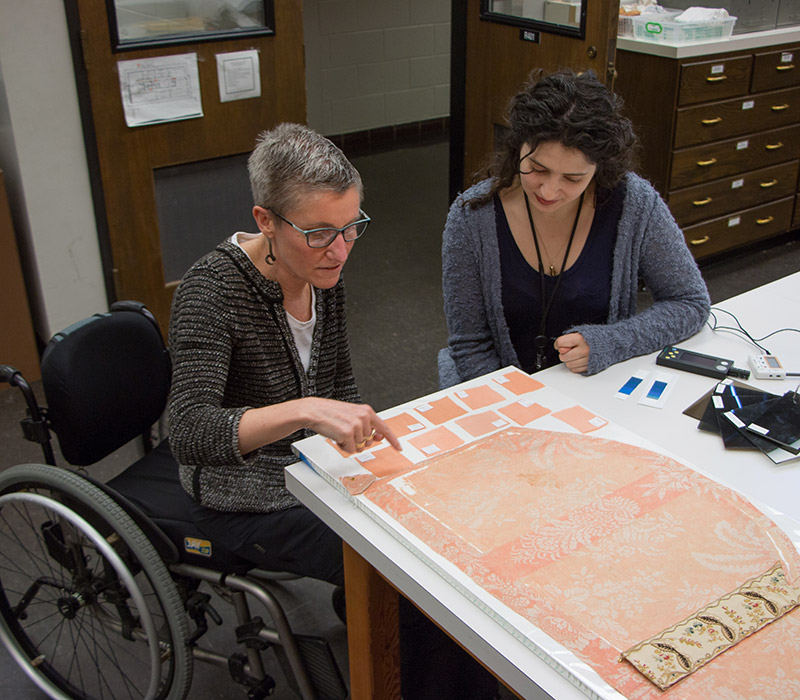
Joelle Wickens teaching Karissa Murtore about light degradation and color-matching in fabric conservation. The image was taken to be intentional about including her wheelchair. (Image credit: Melissa King)
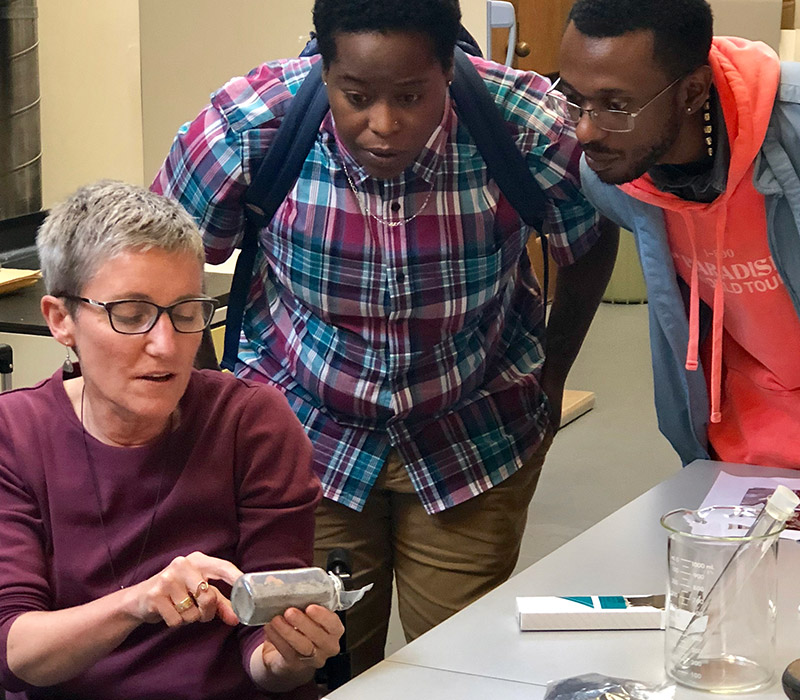
Joelle Wickens teaching Chanise Epps and ArJae Thompson about protecting objects from insect damage. She is sitting in her wheelchair simply it has been cropped from the image, something she used to practice with neat regularity. (Image credit: Debra Hess Norris)
I see this desire to hibernate identities as a barrier, one that requires courage on the part of the underrepresented to reduce. When those with invisible identities are more open, information technology helps people realize that at that place are others in their identity grouping in conservation, even if the number is very depression. I call up that conservators in the dominant group are all-time situated to brainstorm to intermission this barrier. That's why I originally asked you lot, Sarah, to participate in this roundtable: because I knew you had hired an intern with partial paralysis. I did not know virtually your hearing loss. To now know at that place is a director of conservation with an invisible disability may give others the courage to share their hidden disabilities. Give thanks you!
Scaturro: Thank you, Joelle! I've gotten along well without having to actually tell anyone, only I Practise accept hearing loss, and it'due south quite well-hidden! I think my feel has been so much easier because I'chiliad a White woman and have the markers of the dominant group. 1 other non-dominant characteristic is that I come from an economical background that was not always stable and heart-class. Of grade, today I'm solidly middle-class, but there were points in my childhood where my family would shop at church nutrient pantries and day-quondam bread shops, and I was on the costless/reduced-dejeuner program. I never even dreamed that a job in museums would wait me, nevertheless that I would potentially need internships to get into conservation! I could never have worked for free to acquire all of the hours an applicant requires today.
Wickens: Stereotypes and implicit bias are definitely master barriers to inclusion. For instance, people with physical disabilities are oft treated every bit if we are less intelligent. This prejudice is simply wrong, and it's an additional barrier to beingness welcomed in a field that requires advanced degrees.
Kim: In 2014, among people aged 25 and older, 16.iv% of PWD had completed at least a bachelor's degree, whereas 34.6% of people who identified every bit having no disability had completed the same level of instruction. From those same groups, simply 26.1% of PWD were employed and 75.9% of those "with no disability" were employed.thirteen
Prejudices are one primal barrier PWDs face. Some other is that some employers believe that it will be expensive to rent people with disabilities, because of necessary investments needed for them to, equally Livermore et al put it, "to reach the same level of productivity as people without disabilities."14 But in actuality, accommodations are seldom plush, and are worth the investment, every bit shown past a serial of surveys done from 1992 to 1998 by the Job Accommodation Network for the President's Committee on Employment of People with Disabilities. They found minimal productivity difference betwixt PWDs and non-PWDs, and that twenty% of accommodations were made at no cost, eighty% cost $1,000 or less, 17% cost between $ane,001 and $five,000, and 3% cost more than $5,000.15
Wickens: I have had an employer tell me that I should exist happy to be employed by them, fifty-fifty though I was existence paid much less than colleagues with less experience and less education. They justified my low pay considering my healthcare was much more than expensive. This justification is illegal, but information technology is hard to fight for equal treatment.
Information technology's also difficult to enter such a small field, where so much entry into and progression through the field depends on who you know. If people in the field are not intentionally diversifying their circles then we will continue to promote only those who are similar those already in the field.
Kim: There are no statistics nigh PWD in the field of art conservation, then information technology'due south very hard to convince people in power to make change. This is why it is important to do a survey to assemble data, and to address the accessibility needs of current and future conservators, something the Equity and Inclusion Committee of AIC is currently working on. The results should help us determine how to ameliorate recruit and retain people with disabilities. But to make information technology happen and be meaningful, we have to persuade people to take the survey.
Scaturro: I'll admit that it was watching my little blood brother go paralyzed that taught me to reflect on my own biases and fearfulness, and to intentionally welcome those who are differently-abled. I'm not sure I would have the same openness had I not experienced it first-hand with someone I dearest.
Wickens: That speaks to something we hear over and over once again. The best style to get rid of a bias or prejudice is to actually get to know someone from the group you are biased against.
Scaturro: I totally agree.
1 David Mikkelson, "Etymology of Handicap: Did the Word 'Handicap' Originate with the Disabled'due south Having to Beg for a Living?," in Snopes, June xvi, 2011, https://www.snopes.com/fact-check/handicaprice/.
2 Compact Oxford English Dictionary. (Oxford: Clarendon Press Printing, 1993), s.5. "Handicap."
3 Edwin Black, War confronting the Weak: Eugenics and America's Campaign to Create a Primary Race (Washington, DC: Dialog Press, 2012).
4 David Pfeiffer, "Eugenics and Disability Bigotry," in Disability & Society 9, no. four (1994): pp. 481-499.
v US Department of Justice, Civil Rights Division, "Introduction to the ADA," in Data and Technical Assist on the Americans with Disabilities Human action, n.d., https://www.ada.gov/ada_intro.htm.
6 Edwin Black, "The Horrifying American Roots of Nazi Eugenics," in Columbian College of Arts & Sciences: History News Network, September 2003, sec. History.
7 ADA National Network, "An Overview of the Americans with Disabilities Act," in Information, Guidance, and Preparation on the Americans with Disabilities Human activity, n.d., https://adata.org/factsheet/ADA-overview.
8Ibid.
9 The word, Deaf, with an capital "D" is used to describe a person who identifies as being culturally Deaf, uses sign languages and actively engages with the Deaf communities. Deaf with a lowercase "d" is for someone who has hearing loss and does non use sign languages to communicate.
10 American Institute for Conservation, "What is Conservation?" northward.d. https://www.culturalheritage.org/about-conservation/what-is-conservation.
11 US Equal Employment Opportunity Committee, "Job Applicants and the ADA," in Rehabilitation Act, 29 CRF Part 1630, October 2003, https://world wide web.eeoc.gov/laws/guidance/job-applicants-and-ada#:~:text=The%20ADA%20prohibits%20employers%20from,as%20well%20as%20medical%20examinations.
12 The Foundation of the American Establish for Conservation of Historic and Artistic Works. 2014 AIC/FA
IC Conservation Compensation Research Overview Study. Foundation of the American Plant for the Conservation of Historic and Artistic Works, Washington, DC. 2015.
13 U.S. Bureau of Labor Statistics, U.S. Section of Labor. "Persons with a Disability: Labor Force Characteristics Summary 2019," in Economics News Release, February 26, 2020. https://world wide web.bls.gov/news.release/disabl.nr0.htm. U.S. Section of Labor. "People with a inability less likely to have completed a bachelor'southward degree," in The Economics Daily, July 20, 2015.
https://www.bls.gov/opub/ted/2015/people-with-a-disability-less-likely-to-take-completed-a-bachelors-degree.htm
14 Livermore, G.A., Stapleton, D.C, Nowak, M.Due west., Wittenburg, D.C., and Eiseman, East.D., "The Economics of Policies and Programs Affecting the Employment of People with Disabilities," in Rehabilitation Inquiry and Training Center for Economical Inquiry on Employment Policy for Persons with Disabilities, Cornell University, Ithaca, NY. 2000.
15 Ibid.
Master epitome
Sarah Scaturro cleaning a necklace by Simon Costin, "Memento Mori," 1986
in the collection of the Costume Institute, Metropolitan Museum of Art
Alfred Z. Solomon-Janet A. Sloane Endowment Fund, 2006.354a–c.
Courtesy of the Metropolitan Museum of Art
(Image credit: Metropolitan Museum of Fine art)
Prototype clarification: A photograph of art conservator Sarah Scaturro cleaning a necklace by Simon Costin called "Memento Mori," from 1986. Sarah is a low-cal-skinned adult female with dark brown hair pulled dorsum in a bun; she wears a white lab coat, bluish gloves, and a mask. In her left hand, she holds a cotton swab which she uses to clean the textured necklace that she holds still with her right hand.
Source: https://journal.voca.network/a-silent-roundtable-discussion/
0 Response to "Blanton Sarah Scaturro Head Conservator the Costume Institute Metropolitan Museum of Art"
Post a Comment